

What We Lost When We Stopped Reading Aloud
The read-aloud is not a bedtime ritual to be outgrown. It is the curriculum.


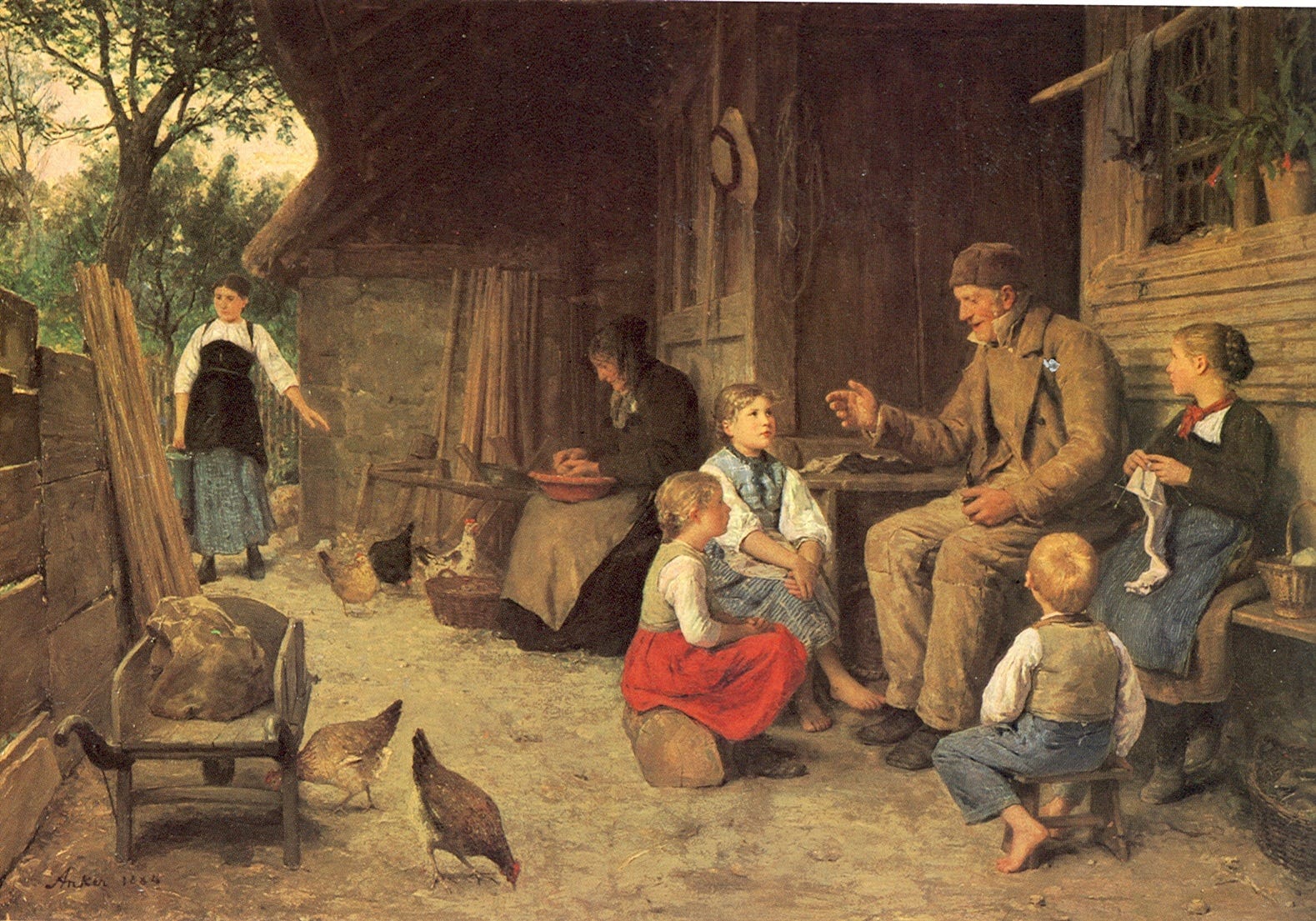
There is a moment in every family when the reading aloud stops. It happens quietly, without ceremony. The child learns to read on his own. The parents feel relief, perhaps even pride. One fewer thing on the schedule. He can read to himself now. Mission accomplished.
We believe this is one of the great mistakes of modern parenting, and we do not think most families realize they are making it.
The read-aloud tradition is the oldest form of education in the world. Long before there were schools, long before there were textbooks, parents were reading to their children. Fathers reciting Homer around a fire. Mothers reading Scripture at the kitchen table. Families gathered in the evening while someone read a chapter of Dickens or Scott or Bunyan aloud, not because the listeners could not read, but because the reading was better together.
We have largely abandoned this practice. And we have lost more than we know.
When We Quit and Why
Most families read aloud to their young children. The bedtime story is still a fixture of early childhood, and rightly so. But somewhere around age seven or eight, when a child begins reading independently, the practice fades. The parents step back. The child picks up books on his own. Everybody assumes this is progress.
In one sense, it is. A child who can read independently has gained something valuable. But he has also lost something, and so has his family. He has lost the shared experience of a story encountered together. He has lost the sound of good prose read well. He has lost the conversation that happens naturally when a family is working through a book at the same pace, hearing the same words, and wondering about the same questions.
Charlotte Mason (1842-1923) understood this. Her educational programs included read-alouds for students well into their teenage years, not because they could not read, but because listening to a book read aloud is a fundamentally different experience from reading silently.1 The ear catches what the eye skims over. The pace is set by the reader, not by the child’s impatience to find out what happens next. There is no skipping ahead. There is no skimming. There is only the story, unfolding at the speed of human speech, and the family listening together.
What Reading Aloud Actually Does
Reading aloud does at least four things that silent reading does not.
First, it builds vocabulary and comprehension beyond the child’s independent reading level. A six-year-old who cannot yet read The Hobbit on his own can follow every word of it when read aloud. Research from the field of literacy education has consistently confirmed that children can comprehend spoken language at a significantly higher level than they can decode written text, and this gap persists through at least middle school.2 When you read aloud to a child, you are feeding his mind at the level it can actually handle, not the level his decoding skills have reached.
Second, it teaches the rhythm and music of good prose. A child who has heard hundreds of hours of well-written English read aloud has internalized sentence patterns, vocabulary, and narrative structure in ways that no grammar workbook can replicate. He has heard how a complex sentence breathes. He knows, without being able to articulate it, what a paragraph feels like when it lands. This is what writers mean when they say you must read to write. They mean you must hear the language, not just see it on a page.
Third, it creates a shared culture within the family. A family that has read The Pilgrim’s Progress together owns a common set of images, phrases, and reference points that will persist for decades. “We are in the Slough of Despond” becomes a family shorthand. The characters become part of the household vocabulary. This is how cultures have always transmitted their stories, not through assigned reading and comprehension quizzes, but through the living voice of someone who loves the story enough to share it.
Fourth, and perhaps most importantly, it gathers the family together around something that is not a screen. In an age when every member of the household is being pulled toward his own device, his own feed, his own algorithm, the read-aloud is a radical act of togetherness. Everyone in the room is hearing the same words at the same moment. No one is multitasking. No one is scrolling. For twenty or thirty minutes, the family is doing something together that human families have done for thousands of years.
The Mistake We Make
The mistake is in thinking that the purpose of reading aloud is to teach a child to read. If that were the purpose, then yes, you could stop once the mission is accomplished. But teaching a child to decode written language is the least of what reading aloud does. It is the bare beginning.
The real purpose of reading aloud is formation. It is the slow, patient work of filling a child’s imagination with worthy images, worthy language, and worthy ideas. It is giving him a store of stories that will shape how he thinks about courage, sacrifice, beauty, and evil long after he has forgotten where he first heard them. This work does not end when a child learns to sound out words on a page. If anything, it becomes more important, because the books worth reading aloud to an older child are the very books that form the backbone of a real education.
Consider what you can read aloud to a ten-year-old that he would likely never pick up on his own. Plutarch’s Lives. The Iliad. Robinson Crusoe. The King James Bible. Beowulf. These are books that reward the ear before they reward the eye. A child who encounters them as read-alouds, with a parent’s voice carrying the unfamiliar language, will absorb them in a way that a child left alone with the text simply will not. He may struggle with the vocabulary on the page. But he will follow the story when he hears it. And the story is what matters.
What We Do
In our home, each child has his own read-alouds suited to his age and interests. The youngest hears different books than the oldest. But we also try to do family read-alouds whenever our schedule allows, and these are the sessions we protect most fiercely. When the whole family is gathered around a single book, something happens that does not happen at any other time in our day. The children are still. The house is quiet. The story fills the room.
We will not pretend this is easy. Life intrudes. Schedules shift. Some evenings everyone is too tired. Some weeks the read-aloud falls off the calendar entirely, and we have to fight to get it back. But when we do, it is always worth it. The children never complain that we are reading to them. They complain when we stop.
This is one of the quiet advantages of homeschooling that no one talks about. The read-aloud is not an extra. It is not a bedtime ritual to be outgrown. It is the curriculum. When we read Fifty Famous Stories Retold, In the Days of Giants, or Stories of Beowulf aloud, we are not supplementing our school day. We are doing school. The living book, read in a living voice, to living children, is the oldest and most effective form of education ever devised. It was good enough for Abraham’s tent, for the Athenian household, for the medieval hearth, and for the colonial parlor. It is good enough for your kitchen table.
Start Tonight
If you have stopped reading aloud to your children, start again tonight. It does not matter that they can read on their own. It does not matter that they are twelve or fourteen or sixteen. Pick up a book that is too good to miss too difficult for them to read alone, or one that they would never voluntarily pick up, and read it to them. Do not ask if they want you to. Just begin.
You will feel awkward at first. So will they. Ignore it. Read a chapter. Then read another one tomorrow. Within a week, they will be asking you what happens next. Within a month, it will be a part of the day no one wants to skip. Within a year, you will wonder how you ever stopped.
C.S. Lewis (1898-1963) once wrote that when he became a man, he put away childish things, including the fear of childishness and the desire to be very grown up.3 Reading aloud to your children is not something you outgrow. It is something you grow into, more and more, as the books get better and the children get older and the conversations around the dinner table begin to reflect the stories you have shared.
Do not let the world tell you your children are too old for this. They are not. Neither are you.
Charlotte Mason, Home Education (London: Kegan Paul, Trench, Trübner & Co., 1886). Mason’s programs included teacher-led reading aloud through all six Forms, extending well into the secondary years.
Andrew Biemiller, “Oral Comprehension Sets the Ceiling on Reading Comprehension,” American Educator (Spring 2003). See also Thomas G. Sticht and James H. James, “Listening and Reading,” in Handbook of Reading Research, ed. P. David Pearson (New York: Longman, 1984), pp. 293-317.
C.S. Lewis, “On Three Ways of Writing for Children,” in Of Other Worlds: Essays and Stories, ed. Walter Hooper (London: Geoffrey Bles, 1966). The original line is: “When I became a man I put away childish things, including the fear of childishness and the desire to be very grown up.”
Wow, I used to laugh about my mom reading to us well after I could read on my own. But reading this I realized how much it connected us at the time. Very cool. I'm happy I found your stuff when my daughter is just 2, it really aligns with who I hope to be as a parent. Thank you for doing the work to put this material out for others.
And we gained a deep-seated fear of reading in front of other children in the classroom