

What Fairy Tales Know That We Have Forgotten
The oldest stories are not relics. They are tools. And your children need them more than you think.

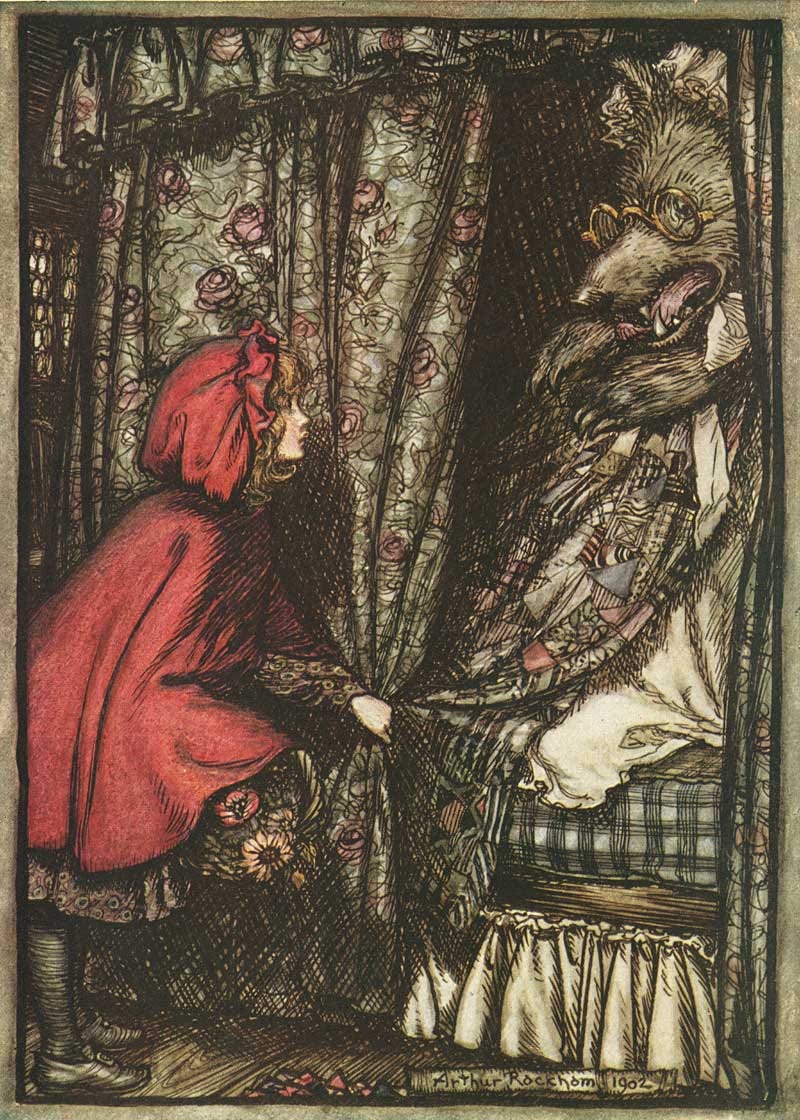
A four-year-old does not need to be told that the world contains frightening things. She already knows. She has known since before she had words for it. The dark hallway, the strange noise, the face that does not look right. Fear is not something we teach children. It is something they arrive with.
What a four-year-old does need is a story in which the frightening thing can be defeated.
This is what fairy tales do. Not the sanitized, Disney-fied, made-for-merchandise versions that line the shelves of chain bookstores. The real ones. The old ones. The stories that have been told and retold for centuries because they contain something that children recognize instinctively, even when adults have forgotten it: The world is dangerous, and courage is possible.
G. K. Chesterton understood this better than almost anyone. Writing in 1909, he addressed the anxious parents of his own era who worried that fairy tales would frighten their children:
Fairy tales do not give the child his first idea of bogey. What fairy tales give the child is his first clear idea of the possible defeat of bogey. The baby has known the dragon intimately ever since he had an imagination. What the fairy tale provides for him is a St. George to kill the dragon.1
Read that again. The dragon is already there. The child already knows about the dragon. What the child lacks is St. George. The fairy tale supplies him.
The Ethics of Elfland
Chesterton went further. In his masterwork Orthodoxy (1908), he made a claim that would have scandalized the serious intellectuals of Edwardian England. He said that everything he needed to know about the world, he had learned from fairy tales:
My first and last philosophy, that which I believe in with unbroken certainty, I learnt in the nursery. I generally learnt it from a nurse; that is, from the solemn and star-appointed priestess at once of democracy and tradition. The things I believed most then, the things I believe most now, are the things called fairy tales.2
This was not nostalgia. Chesterton was making a philosophical argument. Fairy tales, he said, teach children two things that no amount of formal education can replace. First, that the world is strange and wonderful, far stranger and more wonderful than any textbook suggests. Second, that the world operates on conditions. In a fairy tale, everything depends on something. Cinderella can go to the ball, but she must leave by midnight. Jack can climb the beanstalk, but he must be brave enough to face what waits at the top. The girl can save her brothers, but she must not speak for seven years.
These conditions are the moral architecture of the universe rendered in story form. A child who grows up on fairy tales learns, without anyone lecturing him, that actions have consequences, that gifts come with responsibilities, and that the good things of life are not free. They must be earned, or at least received with the right disposition of heart. Chesterton saw in each fairy tale a specific moral lesson, delivered without a trace of moralizing:
There is the chivalrous lesson of “Jack the Giant Killer”; that giants should be killed because they are gigantic... There is the lesson of “Cinderella,” which is the same as that of the Magnificat — exaltavit humiles. There is the great lesson of “Beauty and the Beast”; that a thing must be loved before it is loveable.
That last one deserves a moment. A thing must be loved before it is loveable. That is not a principle you can teach through a worksheet. But a child who has heard Beauty and the Beast told well, who has watched Beauty choose to love what is ugly and frightening because she sees something beneath the surface, has absorbed a truth about love that will serve her for the rest of her life.
Tolkien’s Defense
If Chesterton gave fairy tales their philosophical justification, J. R. R. Tolkien gave them their literary one.
In 1939, Tolkien delivered a lecture at the University of St Andrews titled “On Fairy-Stories.”3 It is one of the most important pieces of literary criticism written in the twentieth century, and only a handful of people dedicated to preserving true literary tradition care to read it anymore. In it, Tolkien identified several qualities that fairy stories offer their readers, chief among them recovery, escape, and consolation.
By recovery, Tolkien meant the ability to see familiar things as though for the first time. We live in a world so saturated with the ordinary that we have stopped noticing it. Trees are just trees. Stars are just stars. Bread is just bread. The fairy story takes these ordinary things and makes them strange again, luminous, worthy of attention. A child who reads about enchanted forests begins to notice real forests. A child who reads about cursed apples begins to look at real apples with something like wonder. The fairy tale washes the film of familiarity from the windows of the world.
By escape, Tolkien meant something that literary critics of his day despised. They sneered at fairy stories as “escapist,” as though wanting to leave the ugliness of the modern world were a character flaw. Tolkien answered them with one of the sharpest lines in all of literary criticism:
Why should a man be scorned, if, finding himself in prison, he tries to get out and go home? Or if, when he cannot do so, he thinks and talks about other topics than jailers and prison-walls? The world outside has not become less real because the prisoner cannot see it. In using Escape in this way the critics have chosen the wrong word, and, what is more, they are confusing, not always by sincere error, the Escape of the Prisoner with the Flight of the Deserter.
The escape of the prisoner. Not the flight of the deserter. A child who reads fairy tales is not fleeing the real world. He is remembering that there is more to the world than what is immediately visible. He is insisting, against all the dreary evidence of daily life, that beauty and heroism and enchantment are real. This is not weakness. This is recognition.
And by consolation, Tolkien meant something very specific. He coined a word for it: Eucatastrophe. The sudden, unexpected turn in a fairy story when everything seems lost and then, against all hope, the good prevails. The dragon is slain. The spell is broken. The lost prince comes home. Tolkien called this “the highest function” of the fairy tale. Not because it offers false hope, but because it insists that the universe is the kind of place where such turns are possible. Where defeat is never final. Where grace can break through.
Tolkien, who was a devout Catholic, saw in the eucatastrophe of fairy tales a reflection of something larger:
The Gospels contain a fairy-story, or a story of a larger kind which embraces all the essence of fairy-stories... The Birth of Christ is the Eucatastrophe of Man’s history. The Resurrection is the Eucatastrophe of the Incarnation.
The fairy tale, in Tolkien’s view, is not a lesser form of literature. It is the form that comes closest to the shape of reality itself.
What Happens When We Remove the Darkness
We live in an age that is deeply uncomfortable with fairy tales in their original form. The wolf is too frightening. The witch is too cruel. The violence is too graphic. And so we soften them. We sand down the edges. We replace the wolf with a misunderstood neighbor and the witch with a victim of circumstance.
The Grimm brothers’ Cinderella ends with the stepsisters’ eyes being pecked out by doves. Their version of Little Red Riding Hood ends with The Huntsman coming to save both Red and her grandmother. In the Paul Galdone version, it is said that the Huntsman “scares the old sinner,” and the wolf dies from his fright. In many modern retellings, the Huntsman is eliminated from the story, leaving Red to her fate as the wolf’s dinner. No redemption nor justice.4
When we remove the darkness from fairy tales, we do not protect our children. We disarm them. We send them into a world full of wolves and witches having told them that wolves and witches do not exist. Chesterton saw it clearly: The child already knows the dragon is real. Take away St. George, and the child is alone with the dragon.
What Happens When We Invert the Morals
There is something worse than softening fairy tales, and that is inverting them.
The past few decades have produced a cottage industry of “reimagined” fairy tales that flip the old stories on their heads. The villain becomes the hero. The hero becomes the oppressor. The moral is reversed. The True Story of the 3 Little Pigs! tells children that the wolf was just misunderstood. Wicked recasts the Wicked Witch of the West as a misunderstood rebel rather than a villain. What began as a clever literary exercise has become the default mode of modern storytelling.
The effects are not trivial. A child raised on inverted fairy tales learns a very specific set of lessons: That proclaimed heroes are probably hiding something. That villains probably have good reasons for what they do. That traditional morality is naive, that virtue is a disguise for power, and that the safest posture toward the world is suspicion.
As the Prophet Isaiah wrote: “Woe unto them that call evil good, and good evil; that put darkness for light, and light for darkness; that put bitter for sweet, and sweet for bitter!”5
The old fairy tales taught children to recognize the wolf. The new ones teach children to sympathize with him. We should not be surprised when a generation raised on sympathetic wolves has difficulty recognizing real ones.
Why the Old Stories Endure
Æsop told his fables twenty-six centuries ago. The story of Cinderella has variants in almost every culture on earth, some dating back thousands of years.6 Jack and the Beanstalk, Beauty and the Beast, Hansel and Gretel, the Three Little Pigs: These stories have survived not because anyone marketed them, not because they won awards, not because they were assigned in schools. They survived because they work. They do something to the human mind that no other form of literature quite manages.
They work because they deal in permanent things. Human nature does not change. The wolf who devoured the lamb in Æsop’s day still devours lambs today; he has merely changed his wardrobe. The witch who lured children with a house made of candy still lures children today; she has merely changed her bait. The courage required to face the giant is the same courage it has always been. The fairy tale endures because the human problems it addresses endure.
They also work because they speak to children in a language children understand. A child does not need an explanation of predatory behavior. He needs to hear about the wolf. He does not need a lecture on the virtue of perseverance. He needs to hear about the third little pig and his house of bricks. He does not need a PowerPoint on the dangers of vanity. He needs to hear about the emperor’s new clothes. The fairy tale translates the abstract into the concrete, the philosophical into the narratable, the moral into the memorable. And it does so in a way that does not moralize or try to spell it out for the readers. It just simply is.
And they work because they are beautiful. Not beautiful in the way that a sunset is beautiful, passively and without effort. Beautiful in the way that a cathedral is beautiful: Built with intention, shaped by centuries of human craft, designed to lift the eyes upward. A well-told fairy tale has a rhythm and a structure that satisfies something deep in the human mind. There is a reason children ask for the same story again and again. They are not bored. They are savoring.
What to Read
If you are persuaded that fairy tales matter and you want to know where to begin, here is what we would suggest.
Start with Æsop. The fables are short, self-contained, and endlessly rereadable. A child of four can follow them. A child of twelve will find new meaning in them. They have been teaching children about human nature for twenty-six centuries, and they have not lost a step. Chapter House publishes J. H. Stickney’s edition because Stickney’s language is clear and direct without being condescending.
Read the Grimm brothers, but read good editions. Not the bowdlerized versions that strip out everything uncomfortable. Children can handle more than we think, and the uncomfortable parts are often the parts that do the most important work.
Read Andrew Lang’s Blue Fairy Book and its companions. The Lang fairy books gathered fairy tales from across the world, translated and adapted largely by Andrew Lang’s wife, Leonora Blanche Lang, and presented in prose that is beautiful without being fussy. These books were standard reading for English-speaking children for generations, and they deserve to be again.
Read mythology. The Greek myths, the Norse myths, the stories of heroes and gods and monsters that form the bedrock of Western imagination. We have written at length elsewhere about why mythology belongs in a Christian home.7 The short version: The Church Fathers themselves read and commended pagan literature. If it was good enough for St. Basil the Great, it is good enough for our children.
And read the fairy tales aloud. A fairy tale read aloud by a parent, in the warmth of a living room, with a child tucked in close, does something that no solitary reading experience can replicate. It creates a shared world. It builds a common language. It deposits in the child’s memory not just the story but the sound of a parent’s voice telling the story, and that memory will outlast almost everything else.
The Seed and the Soil
We do not know which stories will take root in our children’s minds. We do not know which fairy tale, heard at age five or six or seven, will surface decades later when our children face a crisis that no textbook prepared them for. Chesterton learned his philosophy in the nursery. Tolkien built an entire mythology from the raw materials of fairy tales he had loved as a child. C. S. Lewis, who spent his career defending the role of imagination in the moral life, described how George MacDonald’s fairy romance Phantastes had “baptised” his imagination long before his intellect caught up.8
The fairy tale is a seed. You plant it in a child’s mind and you water it with repetition and warmth and the sound of your own voice. You do not dig it up to check on it. You do not measure its progress. You trust that the seed knows what to do, because it has been doing it for thousands of years, in every culture, in every language, in every era of human history.
Your children need these stories. Not because the stories are quaint or charming or nostalgic. Because the stories are true. Not literally true, not historically true, but true in the way that matters most: True to the shape of the world, to the reality of good and evil, to the possibility of courage and the necessity of virtue. True in the way that Chesterton meant when he said that fairy tales are not fantasies. Compared with them, he wrote, other things are fantastic.
The wolves are real. The dragons are real. Give your children St. George.
G. K. Chesterton, “The Red Angel,” in Tremendous Trifles (London: Methuen & Co., 1909). The full passage continues: “Exactly what the fairy tale does is this: it accustoms him for a series of clear pictures to the idea that these limitless terrors had a limit, that these shapeless enemies have enemies in the knights of God, that there is something in the universe more mystical than darkness, and stronger than strong fear.” The famous paraphrase is actually Neil Gaiman’s rewording. The epigraph to his novel Coraline (2002) reads: “Fairy tales are more than true — not because they tell us that dragons exist, but because they tell us that dragons can be beaten.” Gaiman later acknowledged this was his own composition, not Chesterton’s words, though he had forgotten this by the time the book was published.
G. K. Chesterton, Orthodoxy (London: John Lane, The Bodley Head, 1908), Chapter IV, “The Ethics of Elfland.” This chapter is one of the great defenses of fairy tales in the English language, arguing that the conditional logic of fairy tales (you may have the golden castle, but you must not open a certain door) is the true common sense, and that the mechanical determinism of modern rationalism is by comparison a kind of insanity.
J. R. R. Tolkien, “On Fairy-Stories,” originally delivered as the Andrew Lang Lecture at the University of St Andrews on March 8, 1939. First published in Essays Presented to Charles Williams (Oxford University Press, 1947); revised and expanded for Tree and Leaf (George Allen & Unwin, 1964). Tolkien coined the term “eucatastrophe” in this essay to describe the sudden, joyous turn that marks the highest function of the fairy tale. He extended the concept to Christian theology, calling the Resurrection “the eucatastrophe of the Incarnation.”
Paul Galdone, Little Red Riding Hood (New York: McGraw-Hill, 1974).
Isaiah 5:20, King James Version.
The folklorist Marian Roalfe Cox catalogued 345 variants of related tale types in her 1893 study Cinderella: Three Hundred and Forty-Five Variants of Cinderella, Catskin, and Cap o’ Rushes (London: David Nutt, for the Folk-Lore Society). The oldest known variant is often identified as the Egyptian tale of Rhodopis, recorded by the Greek geographer Strabo in his Geographica (composed c. 7 BC to AD 24), though some folklorists dispute whether the Rhodopis story qualifies as a true Cinderella variant. The Chinese variant, “Ye Xian,” dates to the ninth century AD. See also Anna Birgitta Rooth, The Cinderella Cycle (Lund: C. W. K. Gleerup, 1951).
For our extended treatment of this question, see our essay on the Church Fathers and pagan literature in the upcoming Chapter House Chapter I booklet, and our Substack post “Why Virtue and Wonder.” St. Basil the Great’s “Address to Young Men on the Right Use of Greek Literature” (c. 370 AD) remains the definitive Christian argument for engaging with pre-Christian literature.
C. S. Lewis, Surprised by Joy: The Shape of My Early Life (London: Geoffrey Bles, 1955). Lewis purchased Phantastes at Leatherhead station in March 1916, at seventeen (he misremembered himself as “about sixteen” in Surprised by Joy). He wrote: “That night my imagination was, in a certain sense, baptised; the rest of me, not unnaturally, took longer.” Norse mythology had earlier stirred in Lewis an intense longing he called “Joy” or “Northernness,” but it was MacDonald’s fairy romance that converted the imagination toward holiness. The phrase “baptism of the imagination” has become a commonplace in discussions of Lewis’s thought.
I see this in Disney movies, how they soften evil to someone that was just misunderstood or a victim of circumstances. And I think to myself, “where is the actual story?” and “what is this telling our kids about how ‘bad’ evil really is?” It worries me.
Very fine essay, thank you. Well sourced. And Disney is not even “Disney” anymore.
In time (and that time is also always now), the sturdy old myths will reassert themselves — because they are the bedrock under the shifting sands and muds of ephemeral fashion.