

The Most Dangerous Children's Book in the Ancient World
Æsop wrote for tyrants' courts, not for bedtime.

Everyone who reads Æsop’s fables to their children makes the same mistake. They read the story, then maybe they read the moral, and then they ask the child what the lesson was. The child gives the right answer. Everyone feels satisfied. And the real lesson, the one that actually matters, has been completely missed.
Here is something the children’s section of your local bookstore will not tell you: The most celebrated collection of children’s stories in the Western world was not written for children.
Æsop’s fables were born in the most politically dangerous environment in the ancient world: The courts of the Greek tyrants. They were instruments of political speech, crafted to say what could not be said directly. They traveled the courts of men who could have their authors thrown off a cliff for a careless word. And in the end, that is precisely what happened to Æsop.
That is not a detail we tend to mention when we hand our children a book of talking animals. But perhaps we should.
The Man Behind the Animals
The life of Æsop, like the life of Homer, is “involved in much obscurity,” as J. H. Stickney put it in the edition we publish at Chapter House.1 Several cities competed for the honor of claiming him: Sardis, the capital of Lydia; Samos, the island in the eastern Aegean; Mesembria, a Greek colony in Thrace; Cotiaeum in Phrygia. What the ancient sources agree on is this. Æsop was born around 620 BC, and he was born a slave.
Herodotus, our earliest source, names his master as Iadmon of Samos; later tradition adds a second and earlier master, a man named Xanthus. By all accounts, he was a bondsman of formidable wit. Iadmon eventually freed him, recognizing in his slave something that servitude could not contain. From a freedman in Samos, Æsop rose to become one of the most traveled and celebrated men of his age.
One ancient tradition held that he was initially mute, that he only gained the power of speech as a divine gift after showing kindness to a priestess of Isis.2 Whether or not we credit that story, there is something fitting in the image of a man who could not speak freely learning to speak through animals.
His travels took him into remarkable company. He came to Sardis, the golden capital of Lydia, where he pleased Crœsus the king so much that Crœsus applied to him a proverb that became famous: “The Phrygian has spoken better than all.” He moved in the circle of the Seven Sages of Greece, alongside Solon, Thales, and their companions, dining with them at the court of Periander in Corinth. He traveled to Athens. He visited the cities of the Greek world, endeavoring, as Stickney’s introduction records, “by the narration of some of his wise fables, to reconcile the inhabitants of those cities to the administration of their rulers.”3
His end came at Delphi. Crœsus had sent him to the sacred city with a large sum of gold to distribute among the citizens. When Æsop arrived, he found the Delphians so covetous that he refused to distribute the money and sent it back to his master. The Delphians, enraged, accused him of impiety (a charge with the convenient property of being nearly impossible to disprove) and threw him from a cliff.4 He was approximately sixty years old.
Later tradition held that a statue was raised to his memory at Athens, the work of the sculptor Lysippus, though Lysippus lived well over a century after Æsop’s death.
Æsop was not a children’s entertainer. He was a diplomatic instrument: A freed slave, commissioned by a king, traveling from court to court and presenting arguments disguised as fables.
The Age of the Tyrants
To understand what the fables are, you need to understand the world in which they were told. The sixth century BC was, for the Greek world, the Age of the Tyrants. The word did not carry precisely the same meaning then that it carries now. A “tyrant” in the original Greek sense was simply a man who had seized power outside the normal channels of authority.
Some of these men governed tolerably well. Periander of Corinth, at whose table Æsop dined, was counted among the Seven Sages of Greece even as he ruled by consolidated personal power.5 Pisistratus of Athens would later patronize the arts and, per tradition, order the first official texts of Homer. But all of them were men whose authority rested on force. Their courts were not safe for the carelessly honest.
In this environment, the fable became something more than entertainment. The introduction to Stickney’s edition names the function plainly: The fables were “the answer to a need for trenchant, but veiled, characterization of men and measures in the dangerous times of the Tyrants. In mirth-provoking utterances, quite apart from personal criticism, things could be intimated with all the force of specific judgments, yet in such veiled form that to resent them was tacit confession that they applied.”6
Even if a tyrant were to recognize himself in the fable, he could not afford to admit it, lest he be exposed.
The Frogs Who Asked for a King
The most directly political fable in the entire Æsopian collection, the one tradition most firmly connects to a specific historical moment, is “The Frogs Who Asked for a King.” The Roman fabulist Phaedrus, writing in the first century AD, preserved a Latin version and attached a remarkable note: Æsop told this fable to the citizens of Athens when they were complaining about the rule of Pisistratus the tyrant.7
Whether Æsop himself lived to see Pisistratus is doubtful. The ancient sources crowd his life with more rulers than one lifespan can hold: Crœsus, Solon, the Seven Sages, and now Pisistratus, whose rise comes a few years after the date most often given for Æsop’s death.
The Athenians had lived under their commonwealth, with Solon’s laws in place, until political turmoil gave Pisistratus the opening he needed to seize control of the city around 560 BC. His rule was, by the standards of ancient tyranny, relatively mild. But freedom is a thing that men feel most keenly when it is gone, and the Athenians were restless.
Here is the fable as it appears in our edition:
There were once some Frogs who lived together in perfect security in a beautiful lake. They were a large company, and were very comfortable, but they came to think that they might be still happier if they had a King to rule over them. So, they sent to Jupiter, their god, to ask him to give them a King.
Jupiter laughed at their folly, for he knew that they were better off as they were; but he said to them, “Well, here is a King for you,” and into the water he threw a big Log.
It fell with such a splash that the Frogs were terrified and hid themselves in the deep mud under the water. By and by, one braver than the rest peeped out to look at the King, and saw the Log, as it lay quietly on the top of the water. Soon, one after another, they all came out of their hiding places and ventured to look at their great King.
As the Log did not move, they swam round it, keeping a safe distance away, and at last one by one hopped upon it. “This is not a King,” said a wise old Frog, “it is nothing but a stupid Log. If we had a King, Jupiter would pay more attention to us.”
Again, they sent to Jupiter and begged him to give them a King who could rule over them. Jupiter did not like to be disturbed again by the silly Frogs, and this time he sent them a Stork, saying, “You will have someone to rule over you now.”
As they saw the Stork solemnly walking down to the lake, they were delighted. “Ah!” they said, “see how grand he looks! How he strides along! How he throws back his head! This is a King indeed. He shall rule over us,” and they went joyfully to meet him.
As their new King came nearer, he paused, stretched out his long neck, picked up the head Frog, and swallowed him at one mouthful. And then the next, and the next!
“What is this?” cried the Frogs, and they began to draw back in terror. But the Stork with his long legs easily followed them to the water and kept on eating them as fast as he could. “Oh! if we had only been...” said the oldest Frog. He was going to add “content,” but was eaten up before he could finish the sentence.
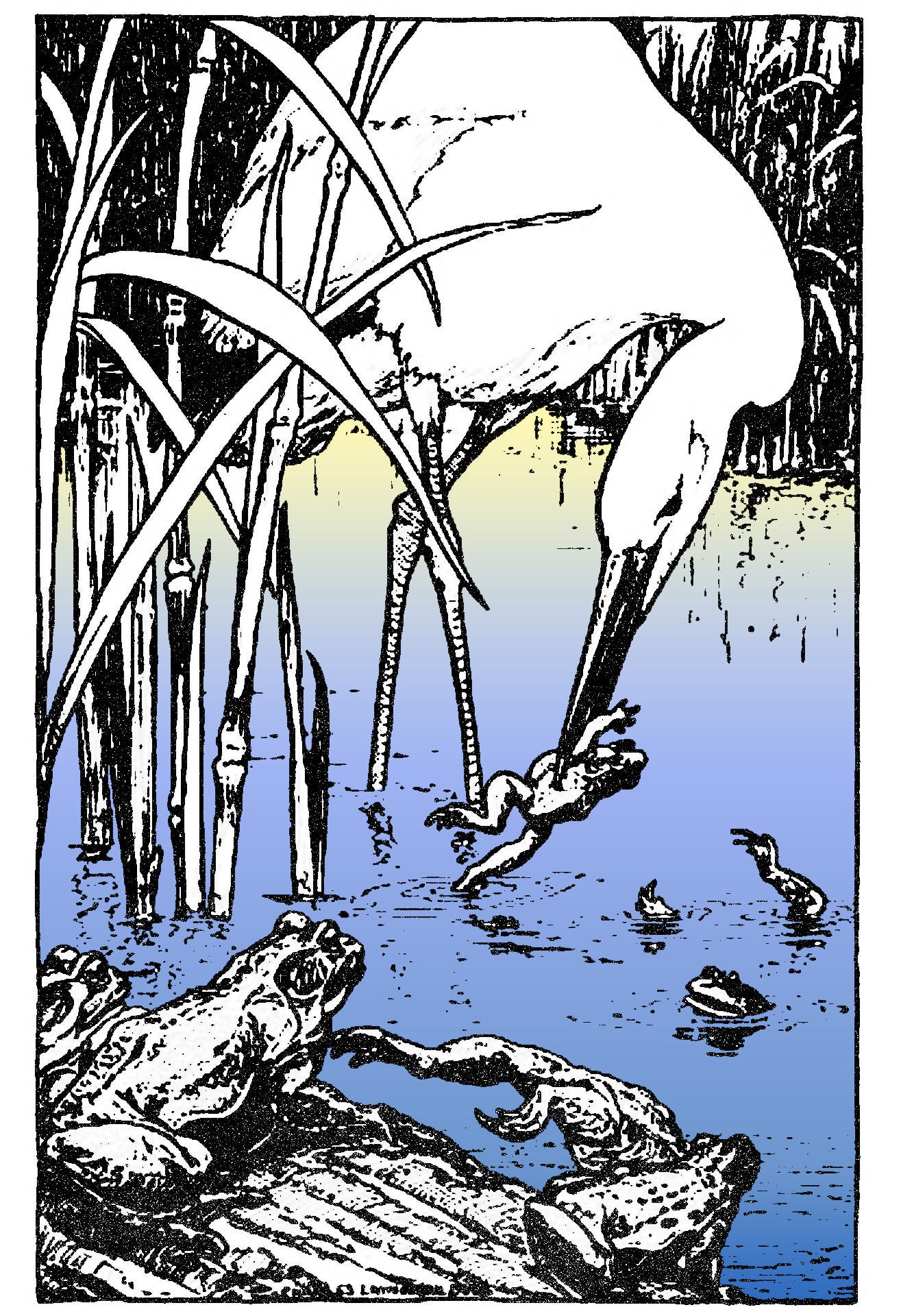
Thus Æsop presents one of the great comic deaths in literature, and also one of the sharpest political observations in the ancient world.
Phaedrus’s version ends with Æsop offering a direct gloss to the Athenians: Accept the ruler you have, imperfect as he may be, or you may find yourself with something considerably worse.8 The message was clear to anyone in earshot, and it was delivered in a form that even Pisistratus could not object to without proving the point. The story was, after all, about frogs.
The Frogs had freedom. They found it insufficient. They demanded a King and received a Log, not because gods are cruel, but because the Frogs did not know what they already possessed. Unsatisfied with the harmless Log, they demanded something with grandeur, with visible authority, with a head that could be thrown back impressively. And they were eaten.
These fables have endured for twenty-six centuries because they do not lecture; they demonstrate.9
Other Animals at the Tyrant’s Court
The Frogs are not alone. Once you read the fables with the political context in mind, the whole collection sharpens.
Consider “The Wolf and the Lamb.” A Wolf and a Lamb come to drink from the same brook. The Wolf wants to eat the Lamb but knows he must have a pretext. So he invents one: You are muddying my water. The Lamb points out that the Wolf stands upstream; this is impossible. The Wolf invents another: You slandered me last year. The Lamb points out that he was not born a year ago. The Wolf, out of arguments, seizes the Lamb anyway: “if it was not you it was your father, so it’s all the same.”10
There is no pretending this is a story about wolves. This is a story about power, and the logic of power when it has decided upon its conclusion and requires only the appearance of justification. The Wolf does not lose the argument and relent. The Wolf loses the argument and eats the Lamb anyway. That is the point. A child who has heard this story carries something with him for life: The knowledge that the arguments of the powerless, however sound, do not always avail them, and that the man manufacturing reasons for an action he has already decided to take is not reasoning but performing.
Or take “The Donkey in the Lion’s Skin,” a short fable about a Donkey who finds a Lion’s hide left out by hunters and puts it on. For a time, it works. He frightens the small and timid animals. Then he meets a Fox, who is not deceived: “My dear Donkey, you are braying, and not roaring. I might, perhaps, have been frightened by your looks, if you had not tried to roar; but I know your voice too well to mistake you for a Lion.”11
False authority is always vulnerable to the observer who listens past the costume to the actual sound. In the court of a tyrant, being that Fox is not a comfortable position. But the Fox’s particular quality of attention, the refusal to be impressed by appearances when the underlying sound is wrong, is precisely what the times call for.
What the Animals Are Actually Teaching
We sometimes suspect that the fables are too simple for serious reading. They are brief. They involve talking animals. The moral lessons are sometimes appended in plain language at the end. It can feel like literature with training wheels.
This is a misunderstanding of what simplicity is for.
A fable takes a truth about human nature, strips away everything accidental and circumstantial and time-bound, and delivers the universal. The Frogs are not sixth-century Athenians specifically. They are every people that has ever been restless under imperfect freedom and traded it for something that looked more impressive and turned out to be fatal. The Lamb is every victim of every rationalized injustice in every era. The Donkey in the Lion’s skin is not any specific fraud; he is fraud itself, and the key to recognizing it is always the same: Listen for the bray inside the roar.
This is why Dr. John Senior placed Æsop at the very beginning of what he called the “thousand good books,” at the Nursery level, suitable even for the very young.12 Not because the fables are easy, but because they are foundational. They form the moral imagination before the analytical intellect arrives to interpret it. A child who has grown up on the fables has been given a vocabulary for the moral life, a set of images and narrative structures that will surface when they are needed.
We do not know which fable will surface in a crucial moment. The Frogs, perhaps, when a generation is tempted to trade a messy freedom for an impressive authority. The Wolf, when someone in a position of power has manufactured a reason for something that needs no real reason at all. The Fox, when the costume is magnificent and the sound underneath it is wrong. But a child who has never heard these stories is navigating without that map. The fables give children names for things that are older than any particular tyrant.
Why We Begin Here
At Chapter House, we publish J. H. Stickney’s edition of Æsop’s Fables as the cornerstone of Chapter I: Heroes and Wonders, our first box set for families. We chose Stickney’s version because the language is clear and direct without condescension, because the original illustrations by Charles Livingston Bull carry a dignity that the cartoon editions rarely achieve, and because the fables are presented without the heavy moralizing apparatus that clutters many modern children’s editions. Stickney trusts the story to do its own work. This is the right posture.
But there is another reason we begin with Æsop. He was a freed slave who walked into the courts of kings and told them things they did not want to hear, wrapped in a form they could not easily punish. He lived in genuinely dangerous times and used beauty as a form of courage. He knew, perhaps better than anyone in the ancient world, what stories are actually for.
We want our children to understand that too, not as a piece of literary history but as a living inheritance.
The fables have survived twenty-six centuries. Tyrants have come and gone. The animals remain, and they are still talking.
We would do well to listen.
J. H. Stickney, ed., Æsop’s Fables: A Version for Young Readers (Ginn and Company, 1915; Chapter House edition, 2026), Introduction, p. xv. The Stickney edition, with original illustrations by Charles Livingston Bull, is available in Chapter I: Heroes and Wonders.
The tradition of Æsop’s initial muteness and miraculous speech is found in the Vita Aesopi (Life of Aesop), a popular ancient biographical romance drawing on sources that predate the fourteenth-century manuscript attributed to Maximus Planudes. The historicity of the Vita‘s details is disputed by scholars; it reads more as literary legend than biography. See Leslie Kurke, Aesopic Conversations: Popular Tradition, Cultural Dialogue, and the Invention of Greek Prose (Princeton University Press, 2011).
Stickney, Æsop’s Fables, Introduction, p. xvi.
Herodotus records (Histories II.134) that Iadmon’s grandson received blood-money compensation for Æsop’s death, establishing the historicity of the execution at Delphi. The tradition of the Phaedriadean Rocks, the cliff from which he was thrown, is consistent across Herodotus, Plutarch (Life of Solon), and Phaedrus (Fabulae, Prologue to Book I).
Periander of Corinth (c. 627–585 BC) was traditionally listed among the Seven Sages of Greece, though his inclusion was disputed in antiquity on account of his cruelties; some ancient lists substituted Myson of Chenae in his place. His connection to Æsop is reported by Plutarch in the Symposium of the Seven Sages (Moralia 146A–164D), where Æsop is shown dining alongside Solon, Bias, Thales, Chilon, Pittacus, and Cleobulus at a banquet hosted by Periander in Corinth.
Stickney, Æsop’s Fables, Introduction, p. xv.
Phaedrus, Fabulae I.2 (”Ranae Regem Petierunt” / “The Frogs Sought a King”). Phaedrus’s preface explicitly sets the scene: Æsop told this fable to the Athenians when they were “groaning under the harsh Pisistratus” and agitating for change. The fable’s closing lines in Phaedrus read: “Accept this servitude, in spite of its severity, / Or you well may fall into one that is worse.” Pisistratus first seized power in Athens around 560 BC; after two periods of exile he controlled the city from 546 BC until his death in 527 BC. Note that this places his rule after the date of c. 564 BC commonly given for Æsop’s death, one of several chronological impossibilities in Æsop’s traditional biography; the attribution should be read as the tradition’s judgment about what the fable was for, not as eyewitness reportage. The Latin text is available at Perseus Digital Library.
Ibid.
Note also the Biblical parallel to 1 Samuel 8, when the ancient Israelites demanded a king.
Stickney, Æsop’s Fables, “The Wolf and the Lamb,” p. 3.
Stickney, Æsop’s Fables, “The Donkey in the Lion’s Skin,” p. 12.
John Senior, The Restoration of Christian Culture (1983; repr. IHS Press, 2008), pp. 154–155. Senior’s “Nursery” reading category (for children approximately ages two to seven) places Æsop alongside Grimm, Andersen, Beatrix Potter, and Lewis Carroll as foundational imaginative literature. For a fuller account of Senior’s educational philosophy and the concept of the “thousand good books,” see our earlier post on John Senior.