

The King Who Fought and the King Who Fled
One nation. One enemy. Two kings, and what set them apart.

Imagine you are the King of England. A foreign occupation has crept into your land, terrorizing and subjugating your people. How would you respond?
Here are the true stories of two kings of England who faced this very situation, from the pages of H.E. Marshall’s magnum opus, Our Island Story, featured in the Chapter IV: The Odyssey of Europe box set.
King Alfred the Great
By the time of King Alfred, the Danes had overrun nearly the whole of his kingdom. He was a king with almost no kingdom left, hiding in the marshes of Somerset. He was so worn down that he sat in a poor woman’s hut and let her cakes burn on the hearth while he brooded, and took her scolding without ever telling her she was scolding her king1.
He could have crossed the sea to safety. Instead, he built a fort2 and gathered the faithful few who would still come to him. Soon after, Alfred’s allies scored a great symbolic victory when they seized the great Danish banner known as The Raven.
Then Alfred did the thing no king was expected to do: He went to scout the enemy himself.
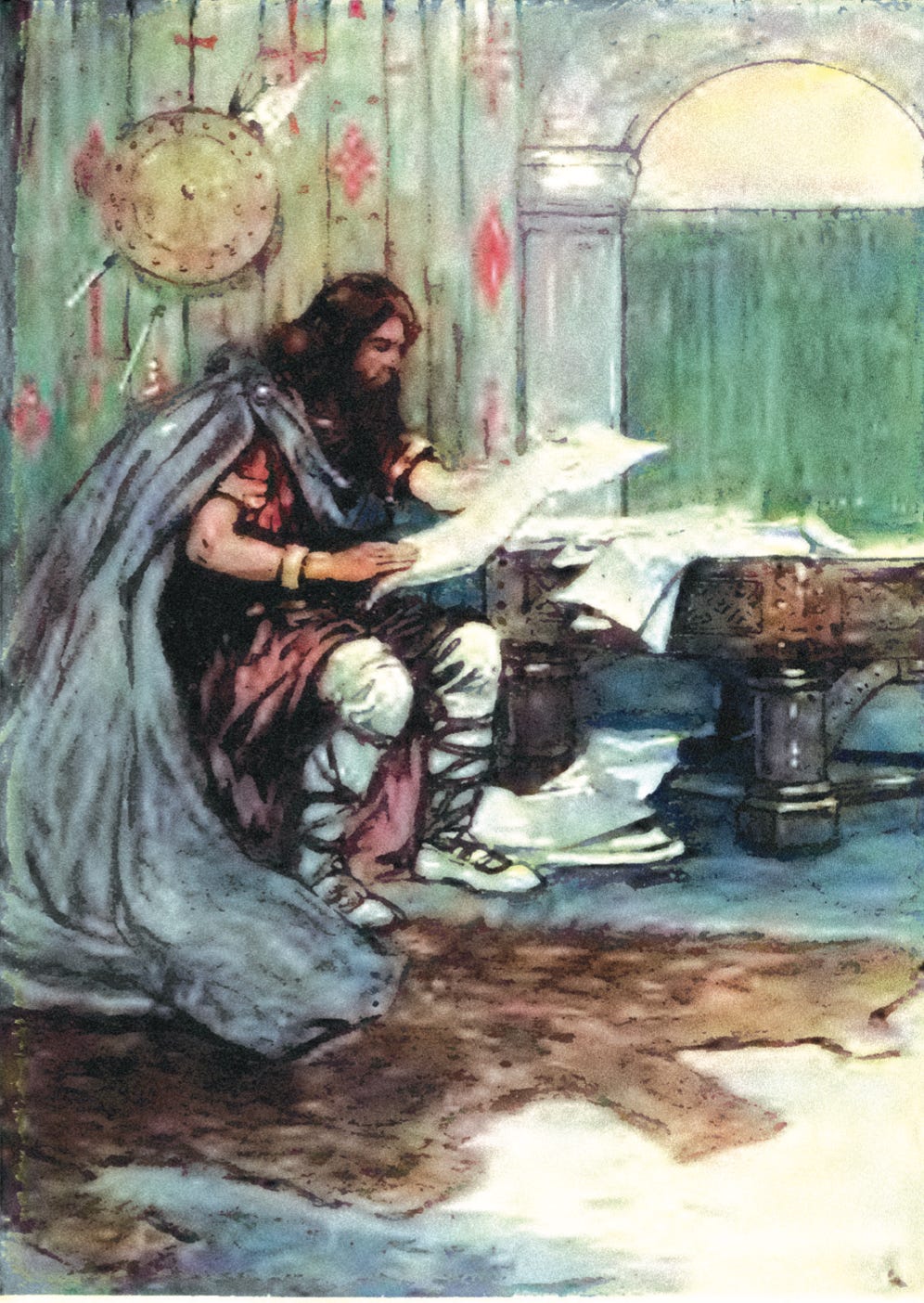
“So he dressed himself like a minstrel or singer, and taking his harp, he went to the Danish camp. There he began to play upon his harp and to sing the songs he had learned when he was a boy.”
The Danes loved music, and they let the gentle singer wander where he pleased. He counted their numbers, learned where the camp was strong and where it was weak, and listened to their king and captains talk. Once he realized that his army was strong enough to defeat them, he returned to his men.
Alfred returned and crushed the Danes. Their king, Guthorm, submitted himself to Alfred and became a Christian. He was baptized as Æthelstan, with Alfred as his godfather. Alfred allowed the Danes to remain in the north of England, in a land called the Danelagh.
Ethelred the Unready
Sadly, Alfred’s peace would not last. A century after his reign, the Danes were growing in number and strength every year.
Year by year, more of them settled, but they refused to integrate:
“They made their homes in England and forgot about their old homes in Denmark. That would not have mattered much, if they had become good English subjects, willing to obey an English king. But that is what they did not do.”
Alfred’s descendant Ethelred now sat on the throne, and the Danes correctly deduced that Ethelred was a fool.
Ethelred’s answer to invasion was the purse. “I will give you a large sum of money if you will go away,” he told them. They took the gold and sailed home, and when it was spent they came again:
“Let us go to England again and rob the people. Perhaps their foolish king will give us more money.”
Over and over, the same thing kept happening, with Ethelred always giving larger and larger sums, only for the Danes to return greedier than before.
To raise what amounted to blackmail, he levied a tax on his own people, called the Danegelt or Danemoney. At first, the English paid it gladly, hoping to buy peace. But the Danes kept coming, and the tax kept climbing, and the hope curdled into the most modern-sounding complaint in the whole book:
“We strive and toil to earn money, that we may live in peace and comfort, but it is of no use. The King takes our money and gives it to these idle heathen. We will work and pay no more.”
Then came the worst of it. Ethelred “thought of another plan … both terrible and wicked,” as Marshall described it. He sent messengers across England ordering that on the thirteenth of November, the people were to kill all the Danes, men, women and children. And lest any child mistake this for justice, Marshall says plainly where the guilt lies:
“It was not the Danes who were living in England who gave the greatest trouble, but those who year by year came across the sea in their ships, to plunder and kill. But Ethelred was weak and cowardly. He dared not fight the fierce sea-kings … so he thought he would murder their peaceful brothers and sisters.”
Alfred turned his courage on the armed enemy; Ethelred turned his cruelty on the unarmed neighbor. The true king is fierce toward the strong and gentle toward the weak. The false king is the other way around: Servile to the dangerous, merciless to the helpless.
Ethelred’s evil plan backfired in spectacular fashion. Among the murdered was Gunhilda, a Christian princess, sister of the King of Denmark, who had married an English lord and spent herself trying to make peace between the two peoples. As she died she said, “my death will bring great sorrow upon England.”
It did.
Her brother’s vengeance brought the invasion that finally broke Ethelred, and in the end, he did the last thing left to a failing guardian. “Deserting his country in the hour of need,” he fled across the sea to Normandy, and sat there in safety, “riding and hunting, and quite forgetting his poor country.”
He appeased, he taxed, he massacred, and he fled. At no point did he defend.
Why Alfred Was Great and Ethelred Was Not
Why was it that Alfred showed such fortitude, bravery, and mercy, while his descendant Ethelred did not? In Marshall’s text, we have what may be a clue.
Alfred loved reading from an early age, and Marshall took great pains to illustrate this. She tells the story of how Alfred and his brothers would crowd around their mother’s knee to look at her picture book of English songs. In those days, such books were rare and expensive.
She promised the book to the first boy who learned to read it on his own. Marshall writes:
He was so eager to have the book that he worked hard all day long. And one morning, while his big brothers were still trying to read the book, he came to his mother and read it without making any mistakes.
Alfred won the prize, and eventually, the crown.
Alfred’s victory over the Danes is not the only reason why he is known as The Great. Alfred, a great lover of books and learning, set out to rebuild the monasteries the Danes had destroyed. He built schools and even translated many books from Latin into English.
Was it those books and his love of learning that gave Alfred the moral imagination to lead England well?
Could it be that as a people grow less learned, less literate, that they grow crueler, less virtuous, and less motivated to defend themselves?
At Chapter House, it is our sincerest hope that the children who grow up reading our humble volumes grow to be leaders who truly care for those in their charge, who have the virtue and boldness to defend them.
Especially the most innocent and vulnerable.
A shorter version of this story for younger readers is recounted in Fifty Famous Stories Retold, part of the Chapter I box set.
Called Athelney or the Isle of Nobles.
Alfred's greatness, I'd argue, sits less in battle than in what he did with his enemy Guthorm, afterwards. Guthrom was entirely at Alfreds mercy and chose baptism over the sword. That is the same mercy Ethelred utterly failed a century later, turning his cruelty on the very people Alfred had once spared. In my view, Alfred was the greatest King England has ever had.