

If You Can Read This, You're Probably Illiterate
The difference between reading words and understanding your own civilization


You are reading these words right now, processing them without difficulty, and so you might assume you are literate. You went to school. You graduated. Maybe you went to college. You can read a menu, follow a recipe, file your taxes. By any modern standard, you are a literate person.
We would like to suggest, as gently as possible, that you may not be.
Not because you cannot decode the symbols on this page. You obviously can. But because literacy, for nearly all of recorded history, meant something far more than that. It meant possessing a shared body of knowledge, a common inheritance of stories and ideas and references that allowed people to communicate with depth, to understand their own civilization, and to think clearly about the world. By that older and more honest standard, most Americans alive today are functionally illiterate. We can read, but we do not know what we are reading.
This is not an insult. It is a diagnosis. And if we are going to fix it, we need to understand how we got here.
What an Eighth Grader Knew in 1912
In 1912, students in Bullitt County, Kentucky gathered at the county courthouse to take their Common Exam. This was not a college entrance exam. It was not a test for gifted students. It was a standard examination for ordinary eighth graders in a rural county, the kind of test you passed before you were considered basically educated.
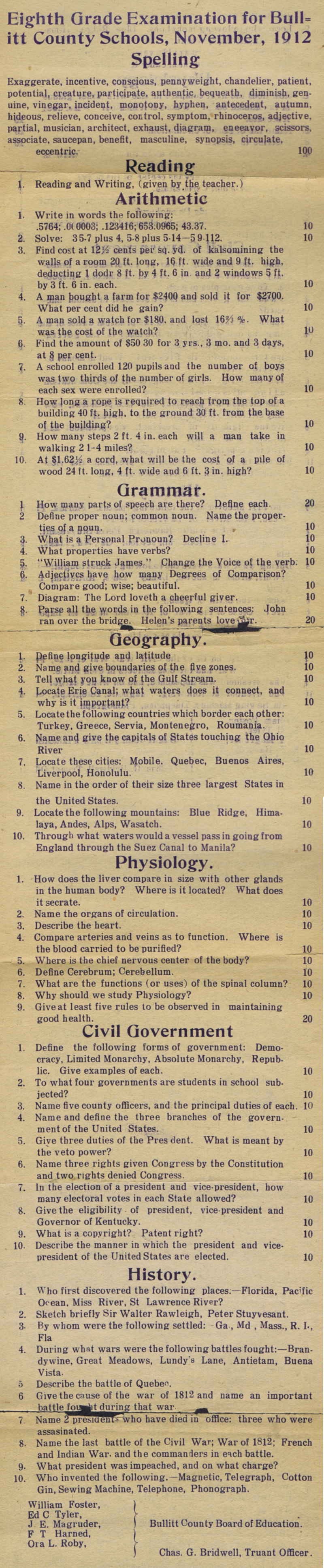
The exam had fifty-seven questions across eight subjects.1 Here is a sample of what it asked of thirteen-year-olds:
Civil government: Define democracy, limited monarchy, absolute monarchy, and republic, and give examples of each.
Arithmetic: Calculate the cost of kalsomining the walls of a room twenty feet long, sixteen feet wide, and nine feet high, at twelve and a half cents per square yard, after deducting one door and two windows of specified dimensions.
Grammar: Parse every word in a sentence, identifying each part of speech and its function.
Geography: Locate Turkey, Greece, Serbia, Montenegro, and Romania on a map, and name which ones border each other.
These were thirteen-year-olds. In rural Kentucky. In 1912.
Today, only thirty-five percent of American high school seniors are proficient in reading, the lowest figure since testing began in 1992.2 The ACT composite score has fallen to 19.5 out of 36, a thirty-year low.3 Between forty and sixty percent of college freshmen require remedial coursework before they can begin actual college courses. Seventy-five percent of those remedial students never graduate.4
We have more schools, more teachers, more funding, more technology, and more years of compulsory education than at any point in American history. And we are producing students who cannot do what a Kentucky farm kid could do in 1912.
The Gate That Closed Behind Us
Consider what it once took to enter college. Harvard’s entrance requirements in 1642 stated plainly that a student must be “able to read Tully or such like classical Latin Author” and “make and speak true Latin in verse and prose” and “decline perfectly the paradigms of nounes and verbes in ye Greeke tongue.”5 This was not a requirement for honors students. This was the door. If you could not read Latin and Greek, you simply did not enter.
By the late 1800s, Harvard still required incoming freshmen to demonstrate knowledge of the whole of Virgil, Caesar’s Commentaries, and Felton’s Greek Reader. Students were expected to write in both Latin and Greek with proper accents. These were eighteen-year-olds. They had not yet begun their college education.
Then the gate closed. Princeton dropped Greek and relaxed its Latin entrance requirements in 1919.6 The others followed. Bryn Mawr dropped the Latin requirement in 1948.7 And with the classical languages went the entire world those languages opened: The philosophy of Aristotle and Cicero in their original words, the poetry of Virgil and Homer, the histories of Thucydides and Livy. Most of us never knew the gate existed.
We do not say this to argue that every child must learn Greek and Latin, though we would not discourage it. We say it to illustrate the distance between what we once expected of an educated person and what we expect now. The bar has not been lowered. It has been buried.
The Century of Decline
The numbers tell the story plainly enough.
In the early 1970s, the average SAT verbal score sat above 530. By 1981, it had fallen to 502.8 Researchers found that a changing test-taking population explained roughly three-quarters of the initial decline in the 1960s, as more students from more backgrounds began taking the exam. But only about a quarter of the continued decline in the 1970s could be similarly explained. The rest was real. Students were simply learning less.
The decline has not reversed. ACT scores peaked in 2007 and have fallen every year since 2018.9 The 2023 average of 19.5 sits below the benchmarks the ACT itself identifies as necessary for success in first-year college courses.
Meanwhile, the appetite for reading has collapsed. The numbers are worth seeing together:
In 2012, twenty-seven percent of students said they read for fun almost every day. By 2023, that had been cut nearly in half, to fourteen percent.10
Nearly a quarter of American adults have not read a single book, in whole or in part, in the past year. That figure has roughly doubled since 1978.11
Over 130 million American adults score at or below the second-lowest level on international literacy assessments.12
The percentage scoring at or below the lowest level of literacy jumped from nineteen percent in 2017 to twenty-eight percent in 2023. A forty-seven percent increase in six years, though changes in test administration may account for some of the shift.13
We have not merely stopped improving. We are going backward.
The Difference Between Reading and Literacy
Here is the distinction that matters: There is a difference between functional literacy and cultural literacy, and our civilization has quietly abandoned the latter while congratulating itself on the former.
Functional literacy means you can decode words. You can read a road sign, a news headline, a text message. You can fill out a form. By this standard, most Americans are literate, and we count this as a success.
Cultural literacy is something else entirely. It means you possess the shared knowledge, references, allusions, and stories that allow you to participate fully in your own civilization’s conversation. When someone says “the writing on the wall,” you know it comes from the Book of Daniel. When someone calls a situation “Orwellian,” you have actually read Orwell. When a politician invokes “crossing the Rubicon,” you understand the weight of what he means because you know who Caesar was and what happened next.
Richard Dawkins, one of the most prominent atheists in the world, once wrote that “a native speaker of English who has never read a word of the King James Bible is verging on the barbarian.”14 He was not making a religious argument. He was making a literary one. Scholars have identified 257 English idioms that trace directly to the King James translation:15 “by the skin of your teeth,” “the writing on the wall,” “an eye for an eye,” “the powers that be,” “a fly in the ointment,” “the salt of the earth.” You cannot claim fluency in the English language without familiarity with this single book, and yet most Americans have never read it.
Then add the foundational stories. Æsop’s fables, which have taught children about human nature for twenty-six centuries. Greek and Norse mythology, which gave us the very words we use for our planets, our days of the week, our constellations. Beowulf, King Arthur, Robin Hood. Fifty Famous Stories Retold, the kind of book that once introduced every schoolchild to William Tell, King Canute, and Sir Walter Raleigh.
These are not decorations. They are load-bearing walls. Remove them and the structure still stands for a while, out of sheer habit and inertia, but it is hollow. The people inside can no longer understand the building they are living in.
How We Got Here
The loss did not happen overnight, and it was not an accident.
In 1912, that Bullitt County exam tested children on civil government, on geography, on grammar, on history. It assumed that an educated person needed to know things, specific things, and that the purpose of school was to ensure he knew them. The purpose of education was the formation of a capable, knowledgeable, and virtuous citizen.
Somewhere in the last century, we traded that vision for another. The purpose of education became economic: To produce workers, to generate credentials, to prepare students for “the workforce.” If a student could read well enough to follow instructions and write well enough to send an email, that was sufficient. The classical languages, the great stories, the shared cultural inheritance, the cultivation of virtue through literature: All of this was deemed unnecessary. Quaint. Outdated.
Dr. John Senior, writing in The Restoration of Christian Culture, put it this way:
Our schools and colleges turn out advanced technicians in what are called the arts and sciences, but none has the ordinary prerequisites to traditional philosophical and theological study, none with the famous mens sana in corpore sano of the ancients.16
We have created a system that is very good at producing employees and very bad at producing educated people.
The result is a peculiar kind of ignorance. We have more access to information than any civilization in history and less capacity to make sense of it. We can Google anything but understand nothing. We can decode words but not grasp the stories behind them. We are, in the most meaningful sense of the word, illiterate.
What Literacy Actually Requires
Literacy is not a skill. It is an inheritance. It is passed down through stories told and retold, through books read aloud at kitchen tables, through the slow accumulation of a shared cultural vocabulary that allows people to speak to one another with depth and precision.
The ancient world understood this. Aristotle said that the good of man is the active exercise of his soul’s faculties in conformity with virtue. Marcus Aurelius told himself to waste no more time arguing about what a good man should be and simply be one. St. John Chrysostom told parents to strive not to make their children rich but rather to make them pious masters of their passions, rich in virtues.
Benjamin Franklin put it in plainer terms: Only a virtuous people are capable of freedom, and as nations become corrupt and vicious, they have more need of masters.
These men were not speaking to scholars. They were speaking to parents, to citizens, to anyone who would listen. For most of Western history, an educated person would have recognized every one of those references without a footnote. They were the common property of literate civilization. They were what you knew. The fact that most readers today will encounter some of these quotations for the first time in this essay is itself the proof of the problem.
What We Can Do About It
We started Chapter House because we believe the old stories still work. Æsop still teaches children about human nature. Greek mythology still fills a child with wonder. The King James Bible still shapes the English language in ways no other book can. These books have been doing their work for centuries. They have not lost their power. We have simply stopped giving them to our children.
We have spent the last two years restoring and curating the twelve books that once formed the common literary inheritance of every educated child, from Æsop’s Fables to the Tales from Shakespeare that Charles and Mary Lamb wrote for young readers. The complete Chapter I through IV Bundle gathers them all. Each volume is cloth-bound, smyth-sewn, and printed in the United States, with a teaching guide for every chapter. The books are ready to read aloud, or to place in a child’s hands when they are ready to read alone.
The fix is not complicated. It does not require a government program or a curriculum overhaul or a national commission. It requires a parent, a child, and a book.
Read Æsop’s fables to your children. Read them the Greek myths. Read them the stories of great men and women who built the civilization they have inherited. Do this consistently, even for just a few minutes a day, and you will be doing more for your child’s literacy than twelve years of institutional schooling will accomplish.
You will also be giving them the keys to their own culture: The shared references, the common stories, the moral vocabulary that allows a person to think clearly and speak meaningfully. You will be making them literate in the way that word was understood for most of human history.
A good gardener does not dig in the soil every day to see how his seeds are progressing. He plants, he waters, he tends. You are planting seeds right now, every time you sit down with your children and a good book. Trust the stories. Trust the process. Trust your children.
You can read these words. Now the question is whether you will do something with them.
The 1912 Bullitt County exam is preserved by the Bullitt County History Museum. Full exam and answer key available at bullittcountyhistory.com. See also “No, You’re Probably Not Smarter Than a 1912-Era 8th Grader,” Smithsonian Magazine, smithsonianmag.com.
National Assessment of Educational Progress (NAEP), 2024 Reading Assessment. nationsreportcard.gov. See also “Reading Scores Fall to New Low on NAEP,” Education Week, January 2025. edweek.org.
“ACT Scores Drop to Their Lowest in 30 Years,” NPR, October 12, 2023. npr.org.
National Center for Education Statistics, “Remedial Coursetaking at U.S. Public 2- and 4-Year Institutions.” nces.ed.gov. Remediation rates of 40-60% reported across institution types. For graduation outcomes, see “16 Upsetting Stats About College Remediation Rates,” whattobecome.com.
Harvard’s 1642 entrance requirements. See Harvard University Archives; also referenced in “Accepted: The Evolution of College Admission Requirements,” Trinity College Digital Repository. commons.trincoll.edu.
“Princeton Abolishes Latin and Greek for Entrance,” The Harvard Crimson, April 21, 1919. thecrimson.com. Greek was dropped entirely; Latin was dropped for science students, who could substitute additional math and modern languages.
History of the Latin Department, Bryn Mawr College. brynmawr.edu. Latin for graduate degrees was dropped in 1937; the undergraduate admission requirement followed in 1948.
Historical SAT data compiled from College Board records using the recentered (post-1995) scale. See “Average SAT Scores of College-Bound Seniors, 1952-2024,” erikthered.com; see also “History of the SAT,” Wikipedia. The College Board commissioned an independent study in 1977 analyzing the causes of the score decline, finding compositional changes explained most of the 1960s decline but only a fraction of the 1970s decline.
“Average ACT Scores Drop for Sixth Year in a Row,” Inside Higher Ed, October 12, 2023. insidehighered.com. ACT composite peaked at 21.2 in 2007. See also “Average ACT Score by Year,” PrepScholar. blog.prepscholar.com.
NAEP Long-Term Trend Assessment, 2023. nationsreportcard.gov. See also “Reading for Fun: Using NAEP Data to Explore Student Attitudes,” Institute of Education Sciences. ies.ed.gov.
Pew Research Center, “Who doesn’t read books in America?” September 21, 2021. pewresearch.org. In 1978, approximately 12% of adults reported not reading a book in the past year; by 2021, that figure had risen to 23%.
National Literacy Institute, “2024-2025 Literacy Statistics.” thenationalliteracyinstitute.com. Figure derived from PIAAC (Programme for the International Assessment of Adult Competencies) data, reflecting adults scoring at Level 2 or below on the PIAAC literacy scale.
PIAAC 2023 National Results, National Center for Education Statistics. nces.ed.gov. See also “Survey: Growing Number of U.S. Adults Lack Literacy Skills,” NBC News. nbcnews.com.
Richard Dawkins, in a column supporting distribution of the King James Bible to British schools. Reported in The Christian Post, “Atheist Richard Dawkins Supports Bibles in Schools.” christianpost.com.
David Crystal, Begat: The King James Bible and the English Language (Oxford University Press, 2010). Crystal identified 257 idioms traceable to the King James translation. See also “Thank the King James Bible for Your Favorite Phrases,” NPR, December 22, 2010. npr.org.
John Senior, The Restoration of Christian Culture (San Francisco: Ignatius Press, 1983; reprinted Norfolk, VA: IHS Press, 2008), Chapter I.
Your assessment is missing a lot of social realities of the time. Child labor laws were not enacted, poverty segregation, and sexism were still rampant. Institutions were educating for the elite and wealthy. As access increased, and diversity grew, education systems had to make it accessible and realistic for the average human being. We also have to mindful of the human being classic education was trying to produce. It was producing an elitist class dissociated from their human instincts and structured to hold up European culture as the civilizing force against an archaic and primitive humanity. This education produced the world we live in today, and clearly much was still missed.
The imperative of understanding the world we live in and its roots is hard placed on an education system. Because it's cerebral, it misses the embodied reality. We need a culturally literate society, but that cannot be mandated with culture. And the coercion, force, and brutality that classical education imposed on young children, does not build whole souls. Unfortunately, neither does modern education. Comparing one with other misses all the cultural advancements we've made, ignores the problems we have still not solved, and promotes eurocentrism, elitism, and intellectualism over a truly well society.
Why should people be expected to know Latin but not Arabic? Equal numbers of classic works have been written in both. Why should people read Chaucer but not Guanzhong? Why is Brahms more important than Coltrane? The idea that certain cultural knowledge is somehow better than others tired at best and ethnocentric at worst.