

Start Before You Are Ready
You don't need to master the classics before reading them to your children


In our last post, we made a broad and alarming statement: That most people are not literate, either culturally or literally, and that our shared culture is suffering for it. While this article was meant to get your attention and make you think, we also have a confession to make:
When we started homeschooling, we had not really read most of the books we now publish through Chapter House.
We knew some of it, of course. We had studied Beowulf in school. We had heard of Æsop, and we definitely knew the story of the Tortoise and the Hare. We had learned a handful of Greek myths in school and through pop culture. But there were enormous gaps, and even the things we thought we knew looked different when we sat down to read them properly, aloud, to a child who was looking at us and waiting for the next page.
Despite having four college degrees between the two of us, we were not truly literate. We were not ready. We started anyway.
That turned out to be one of the best decisions we ever made, and not just for the children. We suspect the number one reason parents do not pick up classic literature with their children is the quiet, nagging fear that they need to master the material before they can teach it. They are waiting to be ready. We want to tell you, from the other side: Do not wait.
Hannah and Our Island Story
When Hannah sat down with Our Island Story for the first time, she did not know what to expect. She knew it was a history of England written for children in 1905. She thought it would start, reasonably enough, with England.
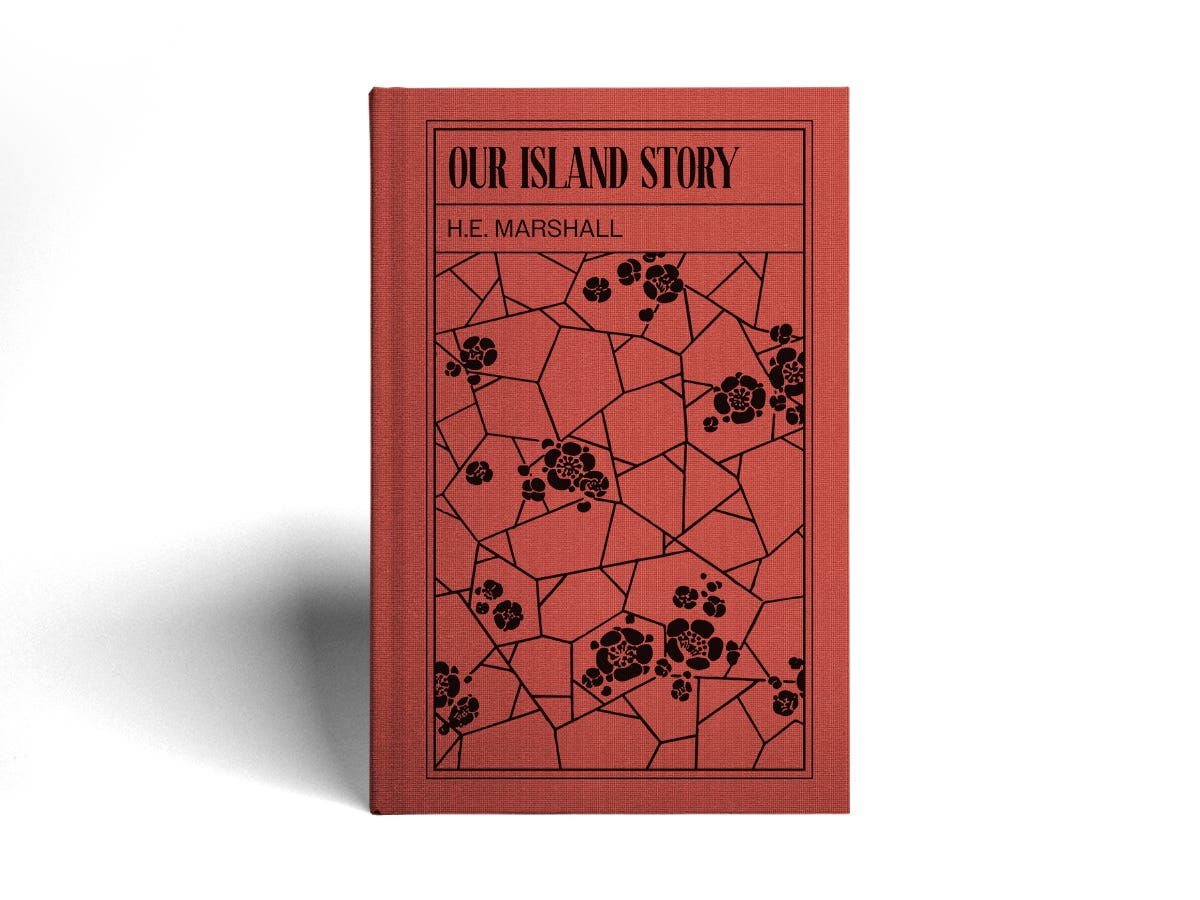
It does not. The very first chapter opens not with England but with Troy. H.E. Marshall begins the story of Britain with a prince called Brutus who sailed from the ruins of that ancient city and gave his name to a new land. Marshall does not mention the Æneid or Virgil by name. She does not have to. Hannah recognized the thread immediately. She had read the Æneid just months before with her Well Read Mom book club, and here was a children’s book that drew on the same mythology, connecting the founding of Britain to the fall of Troy.
The implication was startling: The story of Western civilization is one continuous thread, running from the ancient Mediterranean to a small island in the North Atlantic, and a century ago, children’s authors assumed their readers would see the connection.
She learned something. She was not teaching it. She was encountering it for the first time, alongside the children, and the encounter was real.
Hannah knew a good bit about British history. She has a degree in history and she has visited the British Isles. But the connection she made to Virgil was so unexpected and profound that she realized she was not actually ready. The book did not care. It taught her anyway. That is how it works when you start before you are ready: The material meets you where you are, not where you think you ought to be.
Everything Josh Knew About Norse Mythology Was Wrong
Josh grew up on Marvel Comics, long before they entered the movie business. Of course, everyone is now familiar with the Marvel mythos. We knew that Loki was Thor’s brother, that Odin lost his eye in a battle, and that Thor’s hammer gave him the power to fly. We carried these images around for years, never questioning them, because they came wrapped in the authority of the comics Josh grew up with and a billion-dollar film franchise.
Then we opened In the Days of Giants by Abbie Farwell Brown and discovered that virtually none of it was true.
Loki and Thor are not brothers.
Odin sacrificed his eye willingly to the giant Mimer in exchange for a drink from the fountain of wisdom.
Thor’s hammer does not help him fly; he has a chariot pulled by goats.
Hela, goddess of the underworld, is not Thor’s sister but Loki’s daughter.
The experience was disorienting in the best possible way. We thought we knew these stories, and we did not know them at all. The real Norse myths are stranger, darker, and far more interesting than anything Hollywood has produced. They are also thoroughly alien. If Greek mythology feels like a distant cousin of the Christian imagination (and it is, in many ways), Norse mythology feels like something from another planet entirely. The names are unfamiliar. The spelling looks wrong. The cosmology is bizarre. We spent half our time reading it aloud trying to figure out how to pronounce “Jötunheim” and the other half wondering why no one had ever told us any of this before. If the Greek myths were worthy of a small moment in high school history classes, then surely the Norse myths also were worth a mention.
And our children loved it. They did not care that the names were difficult. They did not care that the mythology was unfamiliar. They cared that there was a magic hammer, a giant wolf, and a serpent wrapped around the entire world. The difficulty that intimidated us did not faze them at all, because they did not yet know he was supposed to be intimidated.
That taught us something we have carried ever since: Children do not share our anxieties about old books. The anxiety belongs to us. They are too busy enjoying the stories.
The Stretching Goes Both Ways
In Charlotte Mason circles, there is a useful concept called a “stretching book.” It means a book that sits just beyond the reader’s current ability, something that forces you to grow into it rather than coast through it. The unfamiliar vocabulary, the complex sentence structures, the references you do not immediately understand: These are not obstacles. They are the exercise.
We wrote about this in our Chapter House booklet for Chapter II, giving parents encouragement to read books beyond the current capabilities of their children. But what we did not fully appreciate when we wrote it is that the stretching goes both ways. The average parent reading In the Days of Giants aloud to a seven-year-old might be stretched just as much as the child is. The parent puzzling through Beowulf, On the Shores of the Great Sea, or Tales from Shakespeare is growing as a reader at the same time as the child. This is not a failure of preparation. It is the design.
Tales from Shakespeare was one we found genuinely intimidating. Shakespeare carries a kind of cultural weight that can make people feel they need permission to approach him. We did not grow up reading Shakespeare for pleasure, and we suspect most of you did not either. What we had of Shakespeare was whatever survived high school English class, which for many of us was one play read badly under fluorescent lights with a teacher explaining what the jokes meant.
But Charles and Mary Lamb wrote Tales from Shakespeare in 1807 precisely for this purpose: To make the plays accessible to young readers who had never encountered them. And when we sat down with it, we found that the Lambs were not dumbing Shakespeare down. They were opening a door. The stories are told simply and beautifully, and they made us want to go back and read the originals, which is exactly what the Lambs intended.
We had never read Cymbeline. To be honest, we had never even heard of this particular Shakespearean work. The Lambs’ version gave us the story, and the story gave us the courage to go back to Shakespeare himself. That sequence (children’s retelling to the original) is not a shortcut. It is a way to become familiar with the stories in a meaningful way before attempting the original works, especially if you are wholly unfamiliar with them.
You Are Not Supposed to Already Know This
Here is the thing no one tells you when you decide to homeschool, or when you decide to read the classics with your children, or when you pick up a Chapter House box set: You are not required to already know this material.
The premise that parents must be experts before they can teach is a modern invention, and it is wrong. For most of history, education happened in households, and the people doing the educating were not specialists. They were parents, grandparents, and older siblings who learned alongside the younger ones. The schoolmaster was a rarity. The home was the school.
Charlotte Mason understood this. Her entire educational philosophy was built on the conviction that children are born persons who learn from living books and living ideas, and that the parent’s job is not to be the fountain of all knowledge but to be a fellow learner.1 She did not expect mothers and fathers to have already read everything on the reading list. She expected them to pick it up and read it with their children, encountering Homer, Plutarch, and the Norse myths for the first time if necessary, and growing from the encounter.
C. S. Lewis made a similar argument from the other direction. In his introduction to St. Athanasius’s On the Incarnation (1944), he wrote that there is “a strange idea abroad that in every subject the ancient books should be read only by the professionals, and that the amateur should content himself with the modern books.”2 Lewis thought this was exactly backwards. Old books are often easier than their reputation suggests. A modern reader who goes straight to the source will frequently understand more than one who reads nothing but modern commentary about the source.
Every age has its own outlook. It is specially good at seeing certain truths and specially liable to make certain mistakes. We all, therefore, need the books that will correct the characteristic mistakes of our own period. And that means the old books.3
Lewis was not writing to scholars. He was writing to ordinary readers. You do not need credentials to read St. Athanasius, Plato, or Homer. You need curiosity and a willingness to be changed by what you find.
The Education You Missed
We will be honest with you. One of the reasons we started Chapter House is that homeschooling showed us how inadequate our own educations had been.
We graduated from schools that were considered good. We passed our tests. We earned our diplomas. And yet we reached adulthood with only the thinnest acquaintance with the books that every educated person in the Western world would have known a century ago. We could name a few of Æsop’s fables, but had never read a proper collection. We had studied Beowulf, but never thought to share it with a child. We had scraps of Greek mythology from childhood, and none at all of the Norse. It was only through homeschooling our own children that we encountered these books seriously, and only after years of reading them as a family that we had the confidence to build a business around them.
This is not unusual. The National Endowment for the Arts reported in 2022 that only 37.6 percent of American adults had read even a single novel or short story in the past year.4 Shakespeare remains functionally unknown to a fifth of British adults, and the American figure is likely higher.5 The great stories of Western civilization, the ones that gave us our idioms, our symbols, our moral vocabulary, have largely been removed from the standard curriculum, and most of us graduated without them.
When you sit down with your children and open Fifty Famous Stories Retold, A Child’s Book of Myths, or On the Shores of the Great Sea, you are not just giving your children something you already have. You are recovering something you were never given. You are getting the education you should have had, delivered a chapter at a time across the kitchen table.
This is one of the secret gifts of homeschooling that no one talks about enough. Parents who teach their children at home consistently report that they learn as much as their children do, often more, because they are encountering the material with adult minds and adult experience. A twelve-year-old reading about Alexander the Great will absorb the adventure. A forty-year-old reading the same passage will see the tragedy, the ambition, the cost of empire, the gap between courage and wisdom. Both readings are valid. Both are enriching. And the fact that they happen at the same table, at the same time, is part of the beauty of the thing.
Start Before You Are Ready
We have talked to parents who want to homeschool but are afraid they are not smart enough, parents who like the idea of a classical education but are intimidated by the word “classical,” and ask, “How am I supposed to teach it?”
You teach it by learning it. That is the answer. There is no other preparation required. And this is true of far more than books.
You will mispronounce names. We still do. (We are never entirely sure about “Mjölnir,” and we have read it aloud dozens of times.) You will encounter stories you have never heard of. Good. Your children will watch you encounter them, and they will learn something more important than any story in any book: That their parents are the kind of people who keep learning. That curiosity is not something you grow out of. That a difficult book is not a closed door but an invitation.
There is no certificate you need, no course you must complete, no shelf of books you must have already finished. You need the courage to stand in front of what you do not know and not be intimidated by it. Every parent who homeschools started before they were ready. That is the only way any of this ever begins.
All you need is a child, a book, and a willingness to read the first page together.
That word, “together,” is the one that matters.
When Hannah finished that first chapter of Our Island Story and sat back in her chair, she was not performing competence for the children. She was genuinely surprised, genuinely learning. And the children saw it. They saw their mother encounter something new and be delighted by it, and that was worth more than any lesson plan.
We did not come to these books as experts. We came to them as parents who wanted something better for our children than what we ourselves had received. We started before we were ready, and the books met us where we were. By the time we started Chapter House, they had made us into different readers and different people.
Start before you are ready. The books will do the rest.
Charlotte Mason, Home Education (1886) and A Philosophy of Education (1925). Mason’s philosophy consistently positioned the parent as a co-learner rather than a lecturer, insisting that “the children, not the teachers, are the responsible persons” and that education is “a life” sustained on living ideas encountered together. Her six-volume series is available at AmblesideOnline.
C. S. Lewis, introduction to St. Athanasius’s On the Incarnation (1944), later collected as “On the Reading of Old Books” in God in the Dock: Essays on Theology and Ethics (1970). Lewis argued that ordinary readers should read old books directly rather than relying on modern interpretations. See the C.S. Lewis Institute.
Lewis, “On the Reading of Old Books”.
National Endowment for the Arts, 2022 Survey of Public Participation in the Arts. Literary reading (novels, short stories, poems, or plays) fell to 48.5 percent of adults, with novel and short story reading at 37.6 percent. See “Federal Data on Reading for Pleasure: All Signs Show a Slump” (2024).
YouGov polling data, various years. In one survey, 20 percent of British adults reported never having read or watched a single Shakespeare play. Given that Shakespeare is more consistently taught in British schools than American ones, the American figure is likely higher.
Amen!
I try not to miss a chance in my classes (whether the class is actually on Norse myth or not), of telling my students that it's Loki and Odin who are (blood-/oath) brothers and not Thor and Loki!