

The Strange Crime of Restoring a Children’s Book
Daniel Lefferts wrote a fine essay about the Hardy Boys. He just buried it under 3,000 words of politics.


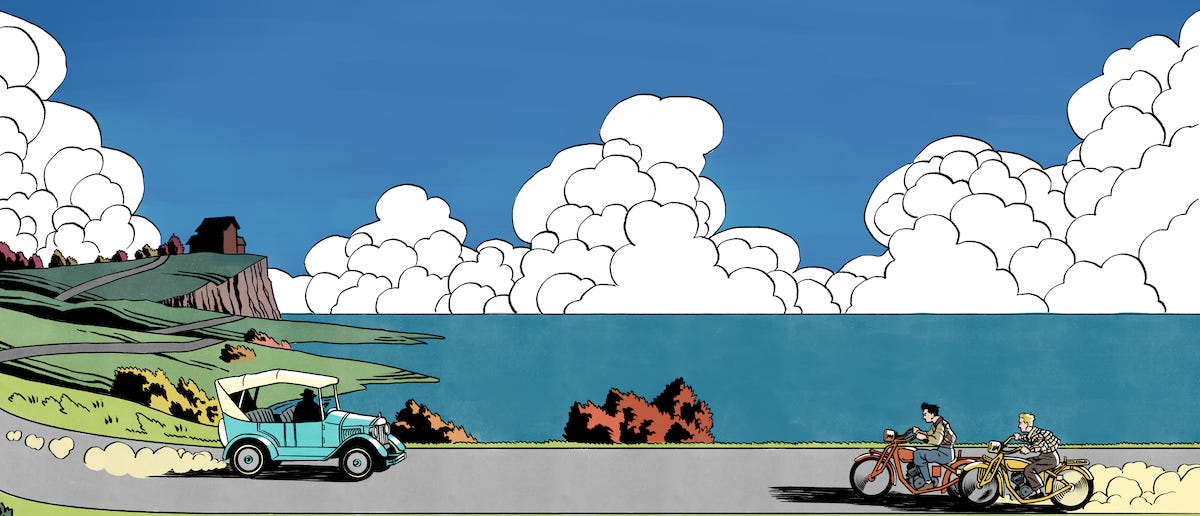
Daniel Lefferts, writing in the New York Review of Books, has published a lengthy essay about the Hardy Boys.1 His thesis, as best we can determine, is that republishing the original, unrevised editions of a beloved children’s series is a politically suspicious act. Lefferts spends several thousand words arriving at this conclusion. He does so, we should note, while conceding along the way that the midcentury rewrites stripped the originals of their complexity, their atmosphere, and their literary quality.
We found this fascinating. Not because we have strong opinions about the Hardy Boys specifically, but because the argument proves something we have been saying for years: There is a segment of our culture that views the act of giving children old, unedited books as inherently threatening.
What Actually Happened to the Hardy Boys
Here is the part of Lefferts’ essay that matters, and the part he seems almost embarrassed to have included.
The original Hardy Boys novels, first published in 1927, were atmospheric, moody, and occasionally lyrical. Beginning in the 1950s, the Stratemeyer Syndicate undertook a sweeping revision of the series. New ghostwriters shortened the books from twenty-five chapters to twenty, simplified the language, stripped out descriptive passages, and flattened complex characters into cardboard. The Bayport police chief, Ezra Collig, went from being what Lefferts calls an “almost noirishly compromised figure” to a cheerful ally. A scene of quiet family grief, in which a woman cries softly while her son stands beside her, his face “white and stern,” was replaced with a fainting spell and smelling salts.
Lefferts quotes both versions of a passage from The House on the Cliff. The 1927 original describes twilight deepening into darkness, lights appearing as a yellow haze through the mist, waves breaking against rocks with a lonely sound. The 1959 revision keeps the twilight and cuts everything else. A child who hears the original is richer for it. A child who gets only “the cliff was a dark smudge” has been cheated.
The Syndicate did this, as Lefferts notes, to appeal to “the shortened attention spans of children accustomed to fast-paced television programs.” The assumption was that children could not handle real writing. It is the same assumption we encounter constantly, and the people doing the simplifying never stop at the offensive parts. They shorten the sentences. They flatten the characters. They cut the descriptions. They strip out everything that made the book a living thing and leave behind a skeleton dressed in modern clothes.
The Concession That Undoes the Argument
Lefferts admits all of this. He acknowledges that the revisions were primarily commercial, not moral. He notes that the offensive content in the originals amounts to “a handful of moments in each novel” consisting of “the sort of crude stereotypes and retrograde turns of phrase you’d expect to find in any number of books written in the early twentieth century.” He concedes that this content was removed “at no cost to the quality of the narratives.”
Lefferts spends the first half of his essay cataloging the political associations of the publisher who restored the originals. Only then does he turn to the books themselves, where he discovers, almost reluctantly, that the originals are genuinely better. Having conceded this, he tries to argue that the restoration must still be politically motivated. But his own evidence works against him.
The logic, reduced to its essentials: The original Hardy Boys novels are better written, more complex, and more literarily interesting than the revised versions. But the wrong sort of people have noticed this. Therefore, the act of republishing them is suspect. This is not literary criticism. It is guilt by bookshelf.
We want to be charitable. Reading the essay carefully, one gets the sense that Lefferts genuinely wanted to write about the Hardy Boys. His close reading is sharp. His comparison of the two versions is well done. It is possible that what we are seeing is not a critic who believes old children’s books are dangerous, but a critic writing for an audience that needs to be reassured, at length, that his interest in these books is not an endorsement of the people who republished them. If that is the case, it is a sad commentary on the state of literary culture: That a writer for the New York Review of Books cannot simply say “these are better books” without first proving his political credentials.
Lefferts himself notes that Applewood Books began reissuing the original Hardy Boys in the 1990s, “albeit with a prefatory note dutifully warning readers that they might find some language ‘extremely uncomfortable.’” That nervous apology tells its own story. The books were good enough to reprint but dangerous enough to require a disclaimer.
At Chapter House, we publish beautiful editions of public domain children’s classics. Fifty Famous Stories Retold. Æsop’s Fables. A Child’s Book of Myths. In the Days of Giants. Stories from Beowulf. We do this because we believe old books belong to everyone. They do not belong to a political movement. They belong to the children who read them and the parents who read them aloud. When a mother reads the story of King Alfred and the cakes to her daughter, she is not making a political statement. She is doing what mothers have done for generations.
The Better Essay, Buried Underneath
Beneath the political argument, Lefferts makes an observation about the Hardy Boys that we wish he had spent more time developing. He notes that the brothers have a complicated relationship with their father, the famous detective Fenton Hardy. They admire him but also see him as a rival. In the original Secret of the Old Mill, they actually withhold evidence from him so they can solve the case themselves. In The Tower Treasure, when a friend tells Frank that Fenton “can do anything,” Frank replies, “I used to think so, too.” Lefferts, citing the literary scholar Tim Morris, notes that Fenton exemplifies “what many think of their own fathers: Utterly powerful, contemptibly inept.”
This is genuinely interesting. It tells us something about childhood, about the passage from admiration to independence, about the moment when a son begins to see his father as a man rather than a monument.
There is an irony here that Lefferts does not seem to notice. He spends the first half of his essay framing the publisher as a vehicle for reactionary nostalgia, an operation devoted to restoring a lost golden age of masculine authority. And then his own close reading reveals protagonists who are suspicious of the past, who view old buildings with dread rather than longing, and who spend their time undermining and outmaneuvering their own father. If these are reactionary texts, they are doing a poor job of it. Lefferts’ literary analysis quietly disproves the political thesis he built to contain it.
The essay ends by asking what young people today will find in the original Hardy Boys novels. We will offer a simple answer: They will find better books. Books with longer sentences and richer vocabulary. Books with complex fathers and complicated heroes. Books that were written before anyone decided that children needed to be protected from the experience of reading something real.
Whether that constitutes a mystery worth investigating, we leave to the reader.
Daniel Lefferts, “The Hardy Men,” The New York Review of Books, April 16, 2026. https://www.nybooks.com/online/2026/04/16/hardy-men-hardy-boys-passage-press/
I was amused by inability of that essay to understand why Passage Press would be interested in books that aren't explicitly anti-woke: “Yet the novels themselves may not live up to the publisher’s anti-woke marketing. It’s hard to imagine that their relatively tame transgressions will do much to excite a far-right audience already awash in racist memes.”
He has no idea what the purpose of publishing these books are, or what kids might gain from reading them.
The situation is literally the opposite – it is contemporary publishing that should be treated with deep suspicion.