

The Curriculum Says Move On. Your Child Says Read It Again.
Why your child learns more the third time through than the first, even when the schedule disagrees


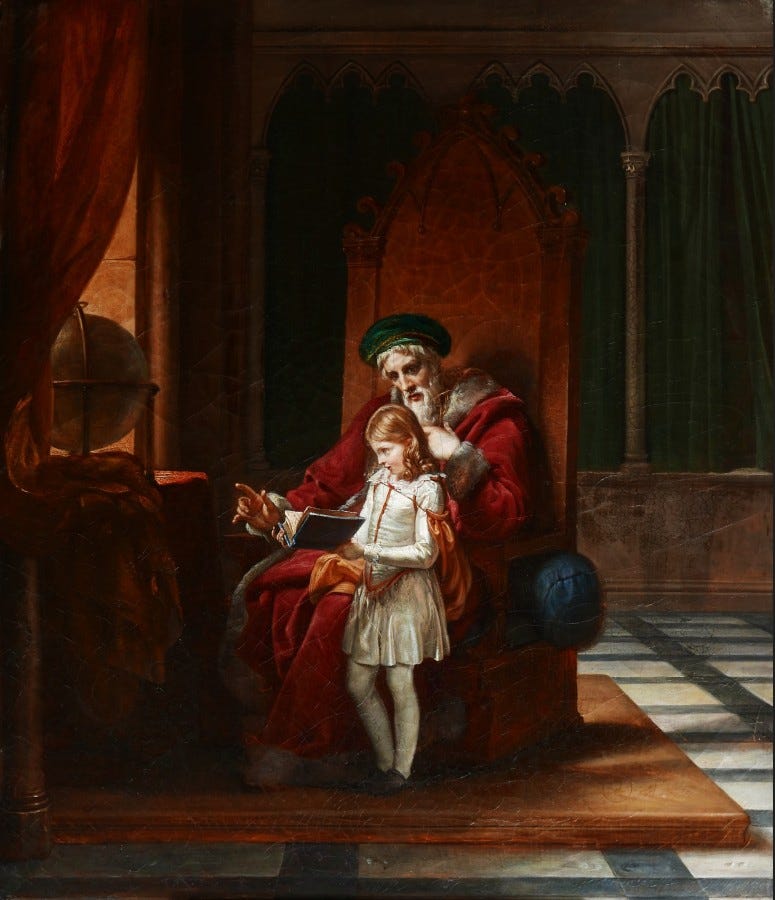
“Again, Mama. Please read it again.”
You have read this book seventeen times. You know every word. You are tired of it. Some quiet, insistent voice in the back of your mind suggests that a good parent would reach for something new, because the schedule says Chapter Four and you are still on Chapter One.
We are asking you to ignore that voice.
Your child is not asking for repetition because he is lazy, or stuck, or failing to progress. He is asking for repetition because his mind is wired to learn the way a garden is wired to grow. The same soil, watered again, produces what a single storm cannot.
What Really Happens the Second Time Through
When a child hears a story for the first time, his attention is consumed by the plot. Who is this person? What does he want? What happens next? The first reading is a sprint across unfamiliar ground. He catches the broad shape of the story, the major characters, the ending. He has made it from beginning to end. He knows what happened.
But knowing what happened is not the same thing as knowing the story.
The second time through, the child is no longer racing to find out what happens. He already knows. Now he is free to notice how the sentences are built, the rhythm of the prose, the precise word chosen when another word might have done. He hears vocabulary he missed the first time, not because it was hidden, but because his mind had more urgent business and pushed it aside. The third time through, he begins to anticipate the language before you speak it. He feels the architecture of the story in his bones. He is not consuming content. He is inhabiting a text.
This is not romantic speculation. It is well established in reading research. Children acquire new vocabulary primarily through repeated exposures in rich contexts, not through single encounters with a word list. (We have written elsewhere about the fifty books we believe every child should encounter before twelve, and every one of them rewards this kind of return.) 1
A 2011 experimental study found that three-year-olds who heard the same storybook read three times in a week learned new vocabulary words from it reliably, while children who heard three different stories introducing the same words the same number of times failed to learn them at all.2 The child who hears the word indignant six times in the same story understands it differently than the child who encounters it once in a workbook.
Syntax works the same way. The complex sentence structures of great prose, the ones that build a child’s internal model of grammar and rhythm, are not absorbed on the first pass. They require repeated immersion, the way a child learning a language needs to hear the same construction used correctly many times before it becomes part of his own speech.
And then there is the emotional layer. The first reading of Charlotte’s Web is a plot experience. The second reading is a relationship experience. The child who already knows Charlotte dies does not skip the hard parts. He leans into them. He weeps, sometimes more deeply than before, because he is no longer frightened by uncertainty. He is grieving a friend he knows well. The third reading, he may begin to notice the beauty of the language that carries the grief, the way E. B. White writes about the barn in winter, the way he slows the sentences down just before the loss. He is learning not only what the story says, but how a story can say it.
A family that reads The Wind in the Willows aloud once has enjoyed an evening. A family that reads it aloud four times has built a language. “This is a Toad sort of afternoon,” one of them will say, and everyone understands. The reckless delight, the refusal to learn, the inevitable crash. That is what a book becomes when you return to it. It lives in the family.
The Guilt That Hurts More Than Repetition
We think the pressure to move on is one of the quietest and most damaging forces in home education, precisely because it is not loud. It does not announce itself. It arrives in the weekly checklist that still has three unchecked boxes. It arrives in the social media post showing what a friend’s fifth-grader read this month. It arrives in the overdue library stack, the unread Amazon book order, the curriculum guide that quietly implies you are behind.
The child, mercifully, does not cooperate. He asks for the same story again because he is doing exactly what his mind requires. He is absorbing the language, the structure, the emotional shape. He is building the base layer upon which every future book will rest. A child who has heard Oliver Twist read aloud four times will read Dickens on his own with a fluency no workbook can produce. He already knows his rhythms. He already trusts his world.
If you feel guilty for reading the same book again, consider that guilt is the wrong feeling entirely. You are not falling behind. You are building forward from a foundation. The child who asks for the same story again is not asking you to stall his education. He is asking you to deepen it.
Five Signs a Book Is Ready to Be Read Aloud Again
How do you know when a book is worth revisiting rather than replacing? There are signs the child gives you, if you are watching for them.
One. He quotes lines before you turn the page.
When a child begins anticipating the language of a text, he is not merely remembering. He is internalizing syntax, rhythm, and word choice. He is making the author’s voice part of his own ear. This is the early stage of literary taste, and it only happens through repetition.
Two. He stops asking plot questions and starts asking character questions.
The first reading, he asks, “What happens next?” The third reading, he asks, “Why did he do that?” This shift from plot to motive is the moment a child begins to read morally, to evaluate choices and consequences. It is one of the most important transitions in literary development, and it almost never happens on the first pass.
Three. He notices details in the illustrations that he missed before.
The first time through a picture book, the pictures are background to the plot. The third time, he sees the expression on the secondary character’s face, the detail in the window, the way the light falls. He is learning to read visually, to understand that a story communicates through more than text. He is also learning patience, the habit of attention that carries over into every other kind of reading.
Four. He acts out scenes during play.
When a child incorporates a story into his independent play, he has moved from reception to ownership. He is not repeating the story exactly. He is remixing it, testing its logic, trying on its characters. This is the deepest form of reading comprehension, and it is impossible without the child knowing the story well enough to carry it around.
Five. He asks for it by name, unprompted, when you reach for a new book.
The child knows what he needs better than the schedule does. When he rejects your offer of something new in favor of the familiar book, he is telling you that the work is not finished. There is more to mine. He should be trusted.
The Permission You Already Have
We are not suggesting you never introduce a new book. Curiosity and novelty are real needs, and a broad library is a genuine good. We are suggesting that you refuse to treat rereading as a failure of progress. Rather, when your child says “again,” you hear it not as a stall but as a request for depth. We are suggesting that the parent who reads The Tale of Peter Rabbit thirty times is doing something just as educationally significant as the parent who reads thirty different books once.
The great stories of our tradition were not composed to be sampled and shelved. They were composed to be revisited, argued with, memorized, and internalized. The books that form a child are the ones he wears out. The ones he returns to at different ages and finds changed, because he has changed. The ones he eventually reads to his own children, and discovers new layers again.
A book does not become a companion on the first reading. It becomes a companion on the third, or the fifth, or the twelfth. Give your child time to love it. Give yourself permission to stay.
Read it again.
Marilyn Jager Adams, Beginning to Read: Thinking and Learning About Print (Cambridge: MIT Press, 1990). Adams discusses vocabulary acquisition through reading in context throughout the book. Separately, a frequently cited estimate in the vocabulary-acquisition literature holds that a child needs roughly eight to twelve exposures to a new word in meaningful context before it is reliably retained. That figure comes from later word-learning research, not from Adams, and estimates in the literature vary.
Jessica S. Horst, Kelly L. Parsons, and Natasha M. Bryan, “Get the Story Straight: Contextual Repetition Promotes Word Learning from Storybooks,” Frontiers in Psychology 2 (2011): 17. The study read specially created storybooks to 3-year-olds three times in a week. Children who heard the same story three times reliably learned new vocabulary from it. Children who heard three different stories, with the target words appearing the same number of times total, failed to learn the words at all.
This is beautifully written and explained. Thank you. The same holds true for classroom teachers. There is so much pressure to move on, get to the next thing, but so much missed (as you described) by not taking time to revisit stories over and over.
Deep wisdom