

The Books We Read to Our Children
Three kids, three very different readers, and the old books that work for all of them


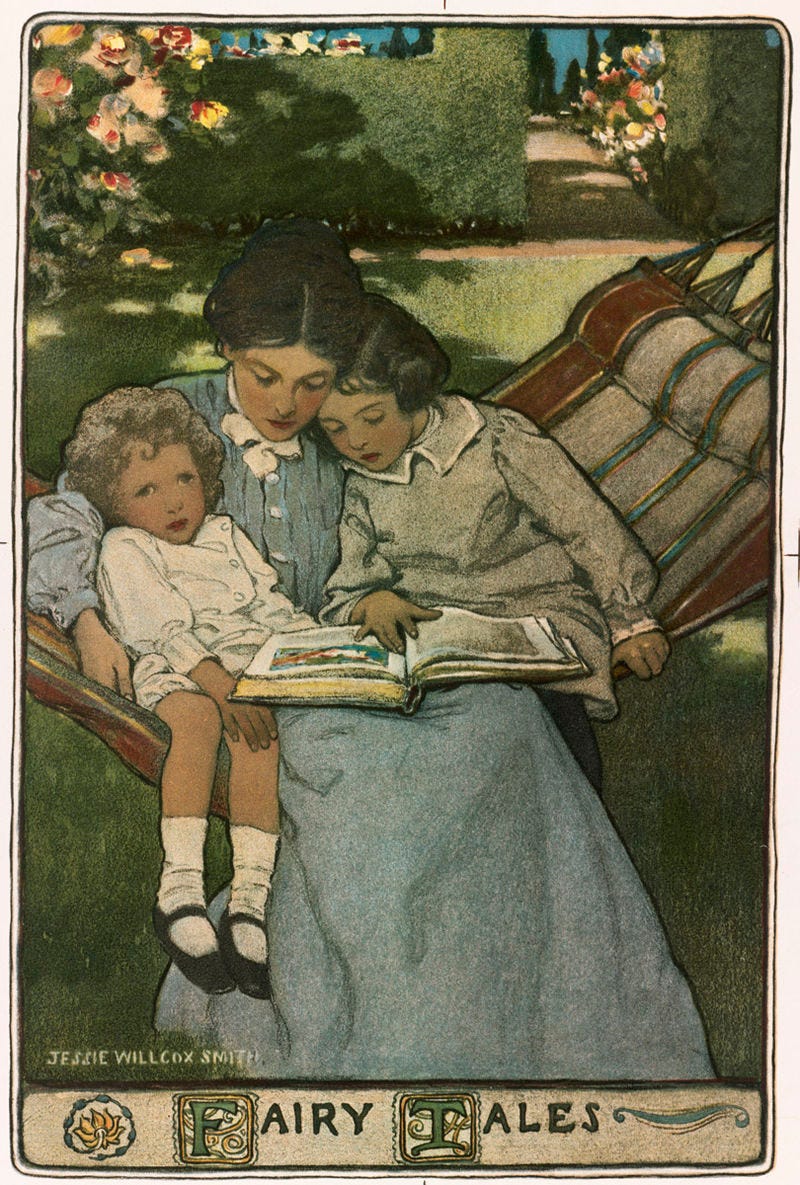
Betsy is four years old and she has opinions about books. Strong ones. She will sit through Brown Bear, Brown Bear, What Do You See? five times in a row without complaint, but if you try to skip a page of Margaret Hodges’ Saint George and the Dragon, she will catch you. She cannot read a word of it herself. She does not care. She knows when you are cheating.
Her brother Stone is seven, and he will sit for Bunnicula or Hank the Cowdog as long as someone is reading it to him. He laughed so hard at Bunnicula one night that he woke up Betsy in the next room. He is in the process of learning to read, but he is not reading everything on his own yet. He does not need to be. What matters right now is that he loves being read to, that he asks for another chapter at bedtime, and that the stories are getting into him whether he realizes it or not.
James is twelve, and he is a different story entirely. James does not love reading. Getting James to sit down with a book has been, at various points over the years, a negotiation, a battle, and an act of faith. We have pulled him to the page more times than we can count. And then one afternoon we found him forty pages into Oliver Twist and pretending he was not enjoying it. He would deny this if you asked him.
We tell you all this because we are not writing from some abstract theory about children’s literature. We are writing from our living room, where three very different children are growing up with very different relationships to books, and where we have spent years figuring out which books to put in front of them and why.
The Problem With Children’s Books Today
Here is something that will not surprise you if you have spent any time in the children’s section of a bookstore: Most of what is published for children today is not very good.
That sounds uncharitable, and perhaps it is. There are exceptions. But the children’s book market has become, in large part, a licensing operation. Walk into any chain bookstore and count how many of the featured titles are tied to a movie, a television show, a toy line, or a social media brand. The books that dominate the shelves are less cultural and intellectual objects than entertainment products looking for mass appeal. They are designed to sell, not to form.
This is not a new complaint. Charlotte Mason, writing more than a century ago, observed that “we have never been so rich in books. But there has never been a generation when there is so much twaddle in print for children.”1 She was writing in the early 1900s. The problem has not improved.
Meanwhile, American children are reading less than at any point in recent memory. Daily reading rates have declined across all age groups, with the steepest drops among children aged eleven to sixteen.2 Children aged eight to eighteen now spend an average of seven and a half hours per day on screens.3 That is not a typo. Seven and a half hours. The book, for many children, has been replaced entirely by a device, not a better book.
We do not say this to shame anyone. Screens are everywhere, and managing them is one of the hardest parts of raising children in this century. But it does mean that the books we choose for our children matter more than ever, precisely because they are competing for attention against a machine specifically designed to capture it. If the book you hand a child is thin, forgettable, and disposable, the screen will win every time. The book has to be better than that.
Why Old Books
We read old books to our children. Not exclusively, but predominantly. And people sometimes ask us why.
The short answer is that old books have already been tested. A book that was written in 1896 and is still being read in 2026 has survived a century of competition. It did not survive because of a marketing budget or a movie tie-in. It survived because generation after generation of readers found something in it worth returning to. That is a filter no bestseller list can replicate.
The longer answer has to do with language. Research has confirmed what any parent who reads aloud already suspects: Books expose children to richer and more varied vocabulary than everyday conversation does.4 But not all books are equal on this count. Older children’s literature tends to use more sophisticated vocabulary and more complex sentence structures than contemporary children’s books.5 The authors of these older works did not write down to their readers. E. B. White did not use the word “garrulous” in Charlotte’s Web because he thought children already knew it. He used it because he thought they could learn it. The same instinct runs through Kipling, through Stevenson, through Kenneth Grahame and George MacDonald and Andrew Lang. They trusted children with real language, and the children rose to meet it.
There is also the matter of what the stories are about. The old stories deal in virtue. Not in a preachy, moralistic way, but in the way that all great stories deal in virtue: By showing it in action. Courage looks like Beowulf taking on Grendel. Loyalty looks like Charlotte spinning her web through the night. Perseverance looks like Lincoln, as a boy, working to pay for a book he damaged because it was the honest thing to do. A child does not need to be told what courage is after he has watched Beowulf fight Grendel. He has seen it. That is the difference between instruction and formation.
C. S. Lewis put it well: “Since it is so likely that they will meet cruel enemies, let them at least have heard of brave knights and heroic courage. Otherwise you are making their destiny not brighter but darker.”6
What We Actually Read and Why
We want to walk you through some of the books we read with our children: Not as an exhaustive list, but as a window into how we think about choosing them.
We start with stories that teach without lecturing. The very first books in our Chapter House collection are Æsop’s Fables, A Child’s Book of Myths and Enchantment Tales for Children, and Fifty Famous Stories Retold. These are the books of Chapter I, and we chose them because they are the oldest and most proven way into the life of the imagination. Æsop has been teaching children about consequences, prudence, and character through animal fables for twenty-six centuries. He has outlasted every educational fad in the history of civilization. That ought to count for something.
The myths do something different. They open a door into wonder: A world where gods walk the earth, where heroes fight monsters, where the line between the human and the divine is thin and luminous.
And Baldwin’s Fifty Famous Stories Retold does something no fairy tale can do: It connects children to real people who actually lived. When your child reads about King Alfred and the cakes, about Bruce and the spider, about George Washington and the cherry tree, he is being grafted into a tradition. He is learning that he comes from somewhere, that the world did not begin the day he was born.
(We have spoken to parents who are nervous about mythology, especially Christian parents who wonder whether pagan stories belong in a Christian home. We understand the concern, and we will address it at length elsewhere. But the short version is this: The Church Fathers themselves—Basil the Great, Augustine, Jerome—were students of pagan literature, and they commended it to others. If it was good enough for them, it is good enough for our children.)
Then we give them books that are harder than they think they can handle. This is the principle behind our Chapter II collection: In the Days of Giants, On the Shores of the Great Sea, and Stories from Beowulf. Norse mythology is not gentle. Beowulf is not gentle. These are stories about blood, sacrifice, courage, and death. They are also stories that seven-year-olds love, because children are braver than we give them credit for.
Stone regularly makes connections in readings that we miss. He asks hard questions and enjoys “hard” books tremendously that we did not necessarily expect him to. The point is not that every child will respond the same way. The point is that if you never hand a child anything difficult, he will never learn that he is capable of difficult things. Reading is a muscle. It has to be stretched.
This same principle is what eventually got James into a biography of Sir Isaac Newton titled The Ocean of Truth. He would never have picked up this book on his own. We put it in front of him. He resisted. He complained. And then, somewhere around chapter five or six, the story got its hooks into him, and he stopped complaining. He still will not admit he liked it, because he is twelve and has a reputation to maintain. But he finished it, and that is a victory worth celebrating. The graphic novels Always with Honor, illustrated by Alex Wisner, worked with James in a way that a lot of prose did not, and we count that as a win too. You meet the child where he is. You keep putting good things in front of him. Sometimes the door is a biography. Sometimes it is a beautifully drawn graphic novel. The point is that the door opens.
We also make room for books that are just fun. Not every book has to be a Great Book with capital letters. Bunnicula is not going to appear on any list of the Western Canon, although the text of Bunnicula makes multiple references to books and authors on the list of Great Books with capital letters. Neither is Hank the Cowdog. But these are the books that teach a child that reading is something you do because you want to, not because someone told you to.
This matters more than people think. Neil Gaiman once argued that there is no such thing as a bad book for children, because “well-meaning adults can easily destroy a child’s love of reading: stop them reading what they enjoy, or give them worthy-but-dull books that you like, the 21st-century equivalents of Victorian ‘improving’ literature.”7 We do not go quite that far. There are plenty of books we would rather our children did not read. But the core point is right. A child who devours Hank the Cowdog at seven is a child who picks up Treasure Island at eleven. A child who reads Bunnicula under the covers at night is a child who is learning that books are a source of private joy. You cannot force that lesson. You can only make it possible.
Stone and Betsy both love Hank the Cowdog and Bunnicula. They love them because the books are funny, and because the characters feel real to them, and because nobody is making them read the books for a lesson. That unforced pleasure is the soil from which a lifelong reading habit grows.
And we mix the familiar with the strange. One of the mistakes we see parents make is building a reading list that is too narrow. Children need range. They need Charlotte’s Web alongside On the Shores of the Great Sea. They need the Blue Fairy Book next to Paddle to the Sea. Mythology beside history. Fiction beside biography. The Wind in the Willows one week and The Phantom Tollbooth the next.
Range builds the kind of mind that can hold multiple worlds at once. A child who reads only one kind of book knows only one kind of story, and a child who knows only one kind of story will have a very limited imagination when the time comes to face the real world, which is stranger and more varied than any single genre can capture.
The Million-Word Gap
One more thing, because the data matters.
A study out of Ohio State University found that children whose parents read to them five books a day from infancy will hear approximately 1.4 million more words by the time they enter kindergarten than children who are never read to.8 One and a half million words. The researchers called it the “million-word gap,” and it predicts differences in vocabulary, reading comprehension, and school readiness that persist for years.
Reading aloud is not a luxury. It is not a quaint tradition. It is one of the most powerful educational interventions available to a parent, and it costs nothing but time and a library card. Jim Trelease spent decades compiling the research on this, and the conclusion is consistent: Reading aloud to children improves their reading, their writing, their speaking, their listening, and their desire to read on their own.9
But here is what the studies do not always say, and what we have learned in our own home: It matters what you read aloud. A thousand hours of reading thin, forgettable books is not the same as a thousand hours of reading Æsop, Baldwin, Kipling, Tolkien, and the King James Bible. The words matter. The sentences matter. The stories matter.
How We Choose
If we had to distill our approach to a few principles, they would look something like this.
Choose books that have survived. Time is the best editor. A book that has been read and loved for fifty years, or a hundred, or a thousand, has earned your trust in a way that last month’s bestseller has not.
Choose books that use real language. Do not be afraid of difficult words, complex sentences, or unfamiliar settings. Children are more capable than we think, and the stretch is where the growth happens.
Choose books that show virtue in action, not books that lecture about virtue. Children can smell a sermon from a mile away. But courage, kindness, loyalty, and honor woven into the fabric of a story will get past every defense.
Choose books that are genuinely enjoyable. A child who hates reading will not become a reader, no matter how good the books on the shelf are. Make room for humor, for adventure, for the books that make a seven-year-old laugh so hard he wakes up his sister.
And know your child. James is not Stone, and Stone is not Betsy. What works for one may not work for another, and that is not a failure. It is parenthood.
We started Chapter House because we wanted to make this easier for other families. We spent years finding these books: Reading them, testing them with our own children, keeping what worked, setting aside what did not. The box sets are the result of that process, and the curriculum we are building around them is an extension of the same principle: Put the best books in front of your children, and trust the books to do their work.
Charlotte Mason called them “living books,” well-written and full of ideas that feed the mind the way good food feeds the body.10 That is what we are after. Not textbooks. Not workbooks. Not “book-like objects” designed to move units. Living books, written by authors who loved their subjects and trusted their readers, placed into the hands of children who deserve nothing less.
A good book is a seed. You do not always know when it will bloom, or how. But you plant it anyway, because that is what good gardeners do.
Charlotte Mason, Home Education (1886), Volume 1 of her six-volume series on education.
National Literacy Trust (UK), “Children and Young People’s Reading in 2024.” The steepest declines were among ages 14-16 (down 10.9 percentage points) and ages 11-14 (down 8.0 percentage points). American data from the National Assessment of Educational Progress (NAEP) shows parallel declines.
Kaiser Family Foundation, “Generation M2: Media in the Lives of 8- to 18-Year-Olds” (2010); updated by Common Sense Media census data (2021, 2024). The 7.5-hour average includes television, computer, smartphone, and tablet use but excludes time spent on screens for schoolwork.
Kate Nation, Nicola Dawson, and Yun-Hsuan Jessie Hsiao, “Book Language and Its Implications for Children’s Language, Literacy, and Development,” Current Directions in Psychological Science 31, no. 5 (2022): 375-380. The researchers found that books have “greater lexical density and diversity than child-directed speech.”
Nicola Dawson, Yun-Hsuan Jessie Hsiao, Andrew Whiten, and Kate Nation, “Features of Lexical Richness in Children’s Books: Comparisons with Child-Directed Speech,” Language Development Research 1, no. 1 (2021). The study found children’s books are lexically richer and more diverse than everyday child-directed speech, with older and more literary works showing the greatest richness.
C. S. Lewis, “On Three Ways of Writing for Children” (1952), originally delivered as a lecture to the Library Association and later collected in Of Other Worlds: Essays and Stories (1966).
Neil Gaiman, “Why Our Future Depends on Libraries, Reading, and Daydreaming,” a lecture delivered at the Reading Agency (October 2013), later published by The Guardian.
Jessica Logan et al., “When Children Are Not Read to at Home: The Million Word Gap,” Journal of Developmental and Behavioral Pediatrics 40, no. 5 (June 2019). The Ohio State University study compared children read to at varying frequencies from birth to age five, finding a gap of approximately 1.4 million words at the highest reading frequency.
Jim Trelease, The Read-Aloud Handbook (1982; 8th edition co-authored with Cyndi Giorgis, 2019). Trelease synthesized decades of literacy research to argue that reading aloud is the single most important activity for building the knowledge required for eventual success in reading.
Charlotte Mason, Home Education (1886), Volume 1 of her six-volume series on education. Mason distinguished between “living books” (written by a single author with genuine knowledge and passion) and the “dry-as-dust” textbooks and compilations that characterized much of Victorian schooling.
I wrote my book, The Rooster Rider, because of the state of children's literature today. Sickened by the slop, I climbed down into the arena and went to work. It has good reviews.
The Rooster Rider, available at Amazon.