

Greek Myths Without the Sanitizing
Why your children deserve the real stories, consequences and all


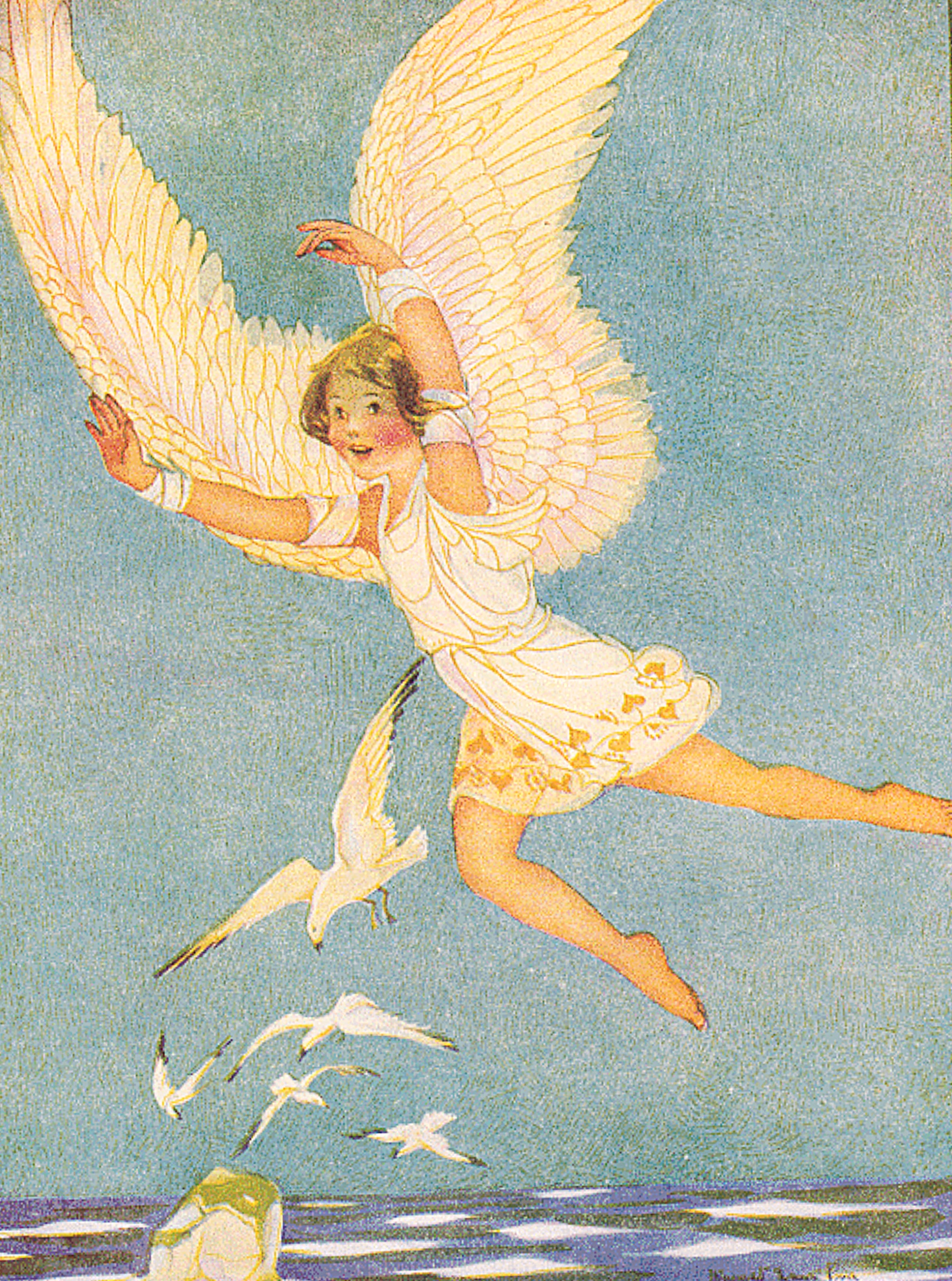
In Margaret Evans Price’s retelling of the myth of Phaeton, a boy begs his father, the sun god Apollo, to let him drive the chariot of the sun across the sky. Apollo warns him. He pleads with him. He tells him it will mean his death. The boy insists. He takes the reins, loses control of the horses, and sets the earth on fire. Jupiter strikes him from the sky with a thunderbolt. Phaeton falls, his hair ablaze, into a river.
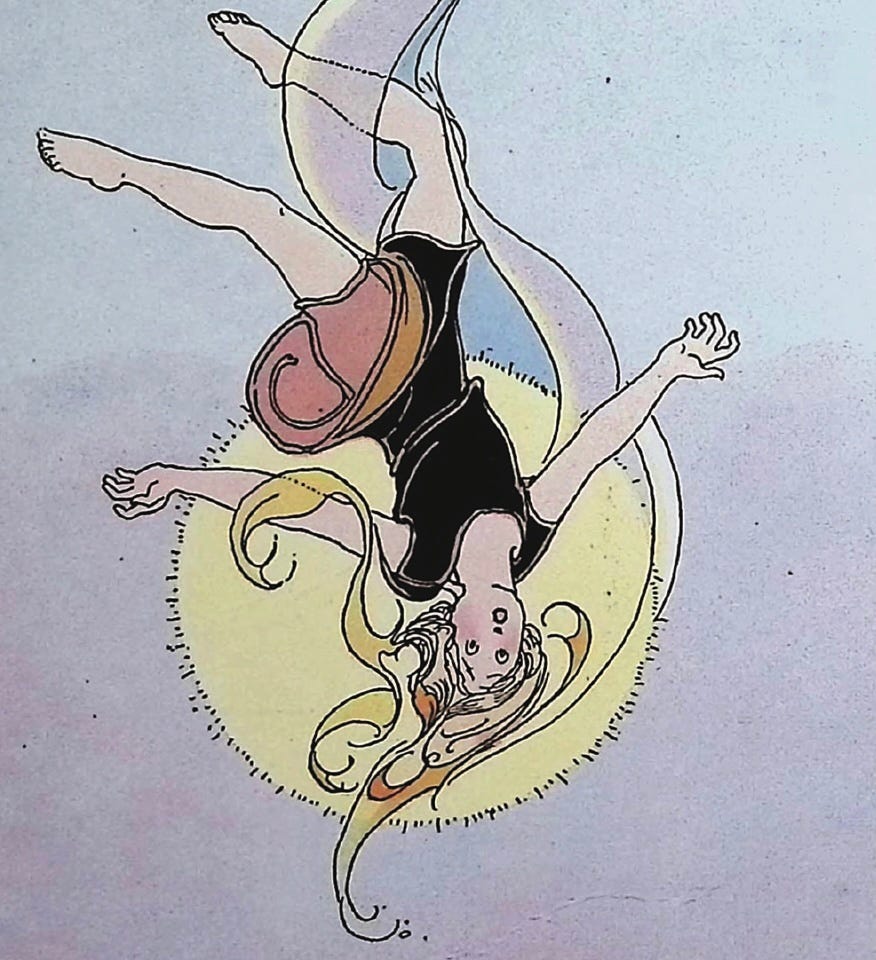
Price published this story in 1924, in a book called A Child’s Book of Myths. It was written for children. Illustrated for children. Marketed to children. And she did not flinch from the ending. The boy dies. His pride kills him. That is the story.
Try to find that version in a modern bookstore. You will have a hard time. What you will find, if you go looking for Greek mythology for kids, is a long shelf of retellings in which the gods are quirky, the heroes are sarcastic, and the consequences have been carefully filed down until they cannot cut anyone. Phaeton might crash the chariot, but he will probably be fine. Niobe might offend the gods, but no one is going to kill all fourteen of her children with arrows while she watches. The Minotaur will be mentioned, but not the fact that Athens sent its young men and women to be devoured by it, as tribute for a lost war.
The stories survive, in a fashion. But the thing that made them stories, the thing that made them matter for three thousand years, has been quietly removed.
What Gets Lost
Greek myths are not entertainment. They are the oldest surviving attempt by Western civilization to answer the questions that every human being asks: Why do we suffer? What happens when we defy the natural order? Is the universe fair? What does it cost to be brave?
The Greeks answered these questions through story, and the answers were not comforting. Icarus flies too close to the sun and drowns. Orpheus looks back and loses Eurydice forever. Prometheus steals fire for mankind and is chained to a rock while an eagle eats his liver, which grows back each night so the torment can begin again. Niobe boasts that she is greater than a goddess, and Diana kills every one of her fourteen children.
These are not stories that coddle their audience. They were never meant to. The Greek myths were designed to teach through shock, through pity, through the slow recognition that the characters on stage are versions of ourselves. Aristotle understood this. In the Poetics, he argued that tragedy produces catharsis: a purging of fear and pity that leaves the audience wiser and more human.1 The audience must feel something real for the catharsis to work. If you sand down the tragedy until it is merely unpleasant, the mechanism breaks. There is nothing to purge.
When we remove the consequences from these stories, we do not make them safer. We make them meaningless. A version of Phaeton in which the boy survives his recklessness is not a myth. It is a cartoon. The entire point of Phaeton is that pride has a price, that the universe does not bend to accommodate our desires, that a father’s love cannot always save his son. Remove the death and you remove the meaning. You are left with a story about a boy who went on a wild ride and came home for dinner.
The Sanitizing Habit
This impulse to protect children from the weight of real stories is not new, but it has accelerated. We see it most clearly in what has happened to fairy tales.
The Brothers Grimm published their tales in 1812. In the original “Cinderella,” the stepsisters cut off parts of their own feet to fit the glass slipper, and pigeons peck out their eyes at the wedding.2 In “Snow White,” the wicked queen is forced to dance in red-hot iron shoes until she drops dead. In “The Juniper Tree,” a stepmother murders her stepson, chops him up, and cooks him in a stew.
These are the versions that European children heard for centuries. They are also the versions that virtually no American child encounters today. What they get instead is Disney, which has done more to reshape Western folklore than any other force in the past hundred years. Disney’s “Cinderella” (1950) ends with a wedding and singing mice. The stepsisters are humiliated but unharmed. The cost of cruelty, in Disney’s telling, is mild embarrassment. The original Grimm version understood that cruelty invites a reckoning. Disney understood that reckonings are bad for merchandise.
We are not interested in bashing Disney for the sake of it. The films are beautifully made, and our children have watched many of them. But we should be honest about what happens when the sanitized version becomes the only version anyone knows. The story stops doing its work. A child who knows only Disney’s “Little Mermaid” (in which the mermaid gets the prince) has absorbed a very different lesson than a child who knows Andersen’s original (in which she does not, and dissolves into sea foam).3 The Disney version teaches that love conquers all. Andersen’s version teaches that love sometimes costs you everything and you do not get it back. Both are true. But only one of them prepares a child for the world as it actually is.
The pattern repeats with mythology. Rick Riordan’s Percy Jackson series, which has introduced millions of children to Greek myths, reimagines the gods as bickering, distracted parents and the heroes as wisecracking adolescents.4 The books are fun. They are not wrong, exactly. But they sit at such an ironic distance from the source material that a child who reads only Riordan may never feel the weight of the originals. When everything is a joke, nothing is serious. When every danger resolves neatly, danger means nothing.
What Price Understood
Margaret Evans Price (1888–1973) was not an academic classicist. She was a children’s author and illustrator who studied art in Paris, traveled Europe to sketch, and later cofounded Fisher-Price with her husband Irving Price, business partner Herman Fisher, and Helen Schelle.5 The first toys she designed were based on characters from her own books. She was, in every sense, a person who understood children and what they needed.
What she gave them, in A Child’s Book of Myths (1924) and its companion volume Enchantment Tales for Children (1926), was the real thing. Not Homer in Greek. Not Ovid in Latin. But honest, beautiful retellings of the myths as they had been told for thousands of years, illustrated with her own paintings, and presented without apology.
Price tells the story of Proserpina and Pluto. Pluto, god of the underworld, seizes Proserpina by the wrist and drags her down to his kingdom. Her mother Ceres wanders the earth in grief, and the world goes barren. This is the Greek explanation for winter: a mother’s sorrow so vast that it kills the crops. Price does not soften Pluto’s violence or Ceres’ anguish. She trusts the child to absorb what he is ready for and to let the rest pass over him.
She tells the story of Niobe, who boasts that her fourteen children make her greater than the goddess Latona, who has only two. Apollo and Diana climb a hill overlooking the city and shoot Niobe’s sons one by one as they play on the plain below. Then they kill her daughters, until only the youngest is left. Niobe falls to her knees, begging. The arrow has already left Diana’s bow. The child dies. Niobe weeps until the gods turn her to stone, and still she weeps, a stream trickling from the rock.
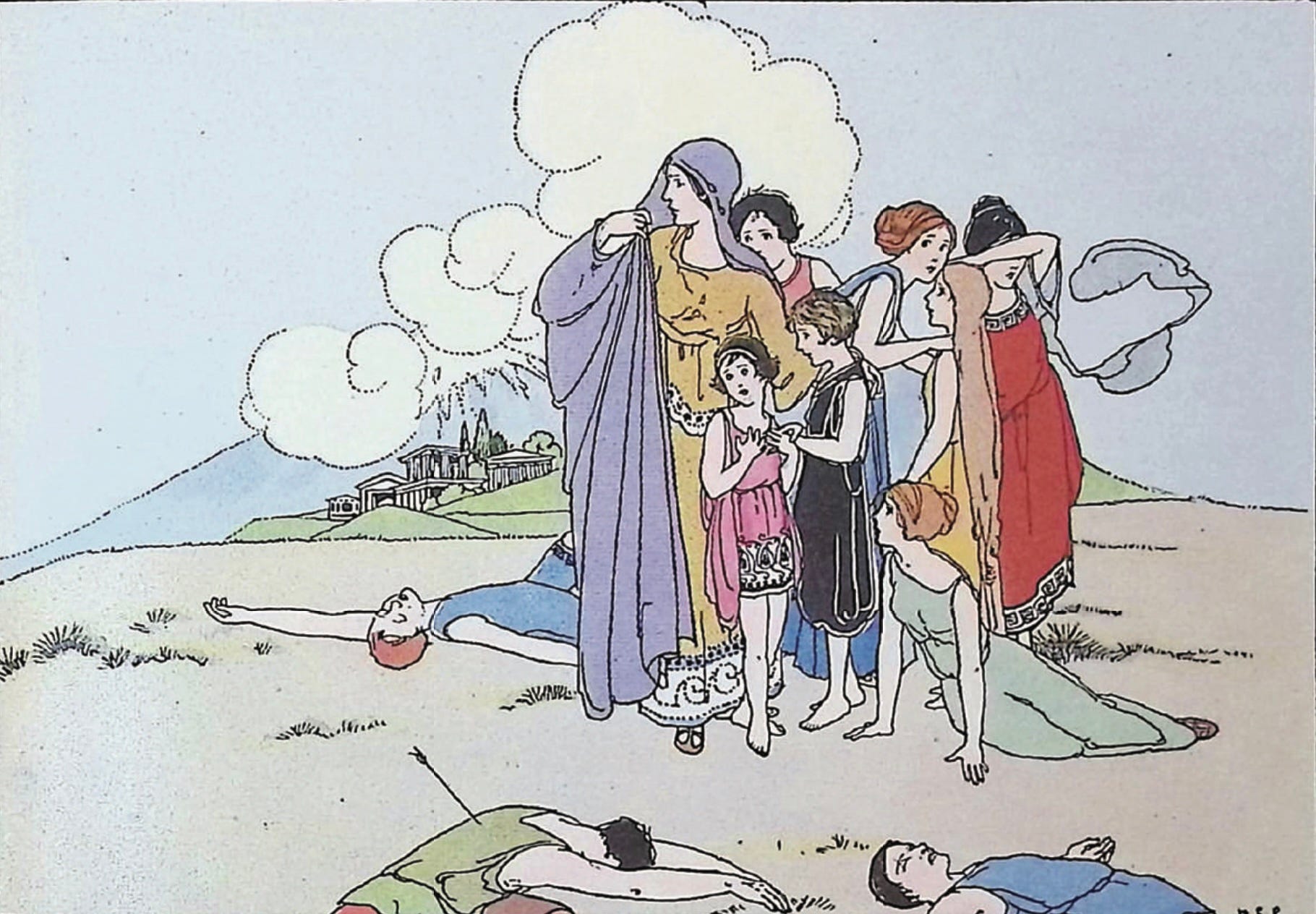
That is a terrifying story. It is supposed to be.6 The Greeks told it to teach a specific lesson: Do not set yourself above the gods. Do not let pride blind you to your place in the order of things. A child who hears this story feels something. He may not articulate it, but he feels the wrongness of Niobe’s boasting and the terrible justice of the punishment, and something inside him adjusts. That adjustment is the whole point.
Katharine Lee Bates, the lyricist of “America, the Beautiful,” wrote the introduction to Price’s original edition. She understood what the myths were doing. “Those wrinkled story-tellers of long ago knew,” Bates wrote, “that we are sometimes allowed, like Aristaeus the Beekeeper, to make amends for our wrong-doing; and that sometimes, like the men Circe had bewitched into beasts, those whom we have harmed are restored to their better selves.”7
The myths teach that wrongdoing has consequences, and that redemption is sometimes possible. But the consequences must be real for the redemption to mean anything.
Why Children Can Handle It
Parents worry. Of course they do. We have worried too. When you sit down to read the story of Niobe to a seven-year-old, there is a moment of hesitation. Should we really tell him that all fourteen children die?
Yes. You should. And here is why.
Children already know that the world is dangerous. They know it instinctively, the way they know gravity. What they do not know is how to think about danger, how to understand suffering, how to place themselves in a moral universe where actions have weight. Stories give them that framework.
G. K. Chesterton, writing in 1909, addressed precisely this anxiety. He was talking about fairy tales, but the principle applies to myths with equal force:
Fairy tales do not give the child his first idea of bogey. What fairy tales give the child is his first clear idea of the possible defeat of bogey. The baby has known the dragon intimately ever since he had an imagination. What the fairy tale provides for him is a St. George to kill the dragon.8
The fear is already there. What the story provides is a way to make sense of it.
We have found this to be true in our own home. Children do not react to difficult stories the way adults expect. An adult reading about Niobe’s children imagines the scene in full sensory detail because he has decades of experience with grief and loss. A seven-year-old hears a story about a proud queen who was punished, absorbs the lesson about pride, and moves on to the next tale. The graphic details that make adults flinch pass over children like wind over a field. They take what they are ready for. The rest waits.
This is what the Chapter I guide for our Chapter House curriculum addresses directly. As we wrote there: “Many details that children will not over-analyze, we, the adults, will fully develop in our minds, due to our breadth of experience with the reality of our material world. We, the adults, will feel more deeply, or be more shocked by, things that children will gloss over and not give a second thought.”9
The hesitation belongs to us, not to them.
The Case for the Originals
We are not arguing that every children’s book must be grim, or that suffering is the only thing that makes a story valuable. There is a place for gentle books, funny books, books that are pure delight. Our children love Hank the Cowdog and Bunnicula as much as they love Greek myths.
But when it comes to the foundational stories of Western civilization, the ones that gave us our symbols, our vocabulary, our moral imagination, half-measures do not work. You cannot tell the story of Icarus without the fall. You cannot tell the story of Prometheus without the chains. You cannot tell the story of Orpheus without the moment he looks back, knowing he should not, and loses everything.
These stories have survived for three thousand years because they tell the truth about human nature. They are, in the deepest sense, education. Not education as job training or test preparation. Education as the cultivation of a soul that can recognize hubris, feel compassion, understand sacrifice, and distinguish between courage and recklessness. That is what the Greeks gave us. It would be a strange kind of gratitude to accept the gift and then remove everything that makes it worth having.
St. Basil the Great, the fourth-century bishop and theologian, counseled young men to read the pagan authors and to take what was good from them. “While receiving whatever of value they have to offer,” he wrote, “you yet recognize what it is wise to ignore.”10 Basil was not worried that Greek literature would corrupt his students. He was worried that ignorance of it would leave them unprepared. The myths trained discernment. They showed virtue in action and vice in its consequences, and they expected the reader to tell the difference.
That expectation is a form of respect. When we hand a child a sanitized myth, we are telling him, whether we mean to or not, that we do not trust him with the real thing. When we hand him Price’s A Child’s Book of Myths, we are telling him the opposite. We are telling him that the old stories are his inheritance, that he is strong enough to receive them, and that the world they describe, a world of beauty and terror, courage and consequence, is the world he actually lives in.
We publish Price’s A Child’s Book of Myths and Enchantment Tales for Children as part of the Chapter House Chapter I: Heroes and Wonders set, alongside Æsop’s Fables and Fifty Famous Stories Retold. We chose it because it does what every good book of Greek mythology for kids should do: It tells the truth, beautifully, and trusts the child to grow into it.
The myths will do the rest.
Aristotle, Poetics, 6.1449b. Aristotle defined tragedy as an imitation of an action that, “through pity and fear,” effects “the proper purgation of these emotions.” The Greek word he used, katharsis, has been debated for centuries, but the core insight remains: Tragedy works by making the audience feel real emotions about fictional events, and the feeling itself is instructive.
Jacob and Wilhelm Grimm, Kinder- und Hausmärchen (Children’s and Household Tales), first published in 1812. The Grimms revised the tales across seven editions, removing sexual content and adding Christian elements while intensifying the violence of punishments for villains. The eye-pecking in “Cinderella,” for instance, was added in the 1819 second edition. The 1857 seventh edition is the version most commonly cited today.
Hans Christian Andersen, “The Little Mermaid” (Den lille Havfrue), first published in 1837. In Andersen’s original, the mermaid sacrifices her voice for legs, endures agony with every step, fails to win the prince’s love, and rather than murder him to save herself, throws herself into the sea and dissolves into foam. Disney’s 1989 adaptation reversed the ending entirely.
Rick Riordan, The Lightning Thief (New York: Miramax Books, 2005). The first book in the Percy Jackson and the Olympians series. The original five-book series has sold tens of millions of copies worldwide.
Margaret Evans Price (1888–1973). Price cofounded Fisher-Price in 1930 with her husband Irving Price, Herman Fisher, and Helen Schelle. The first Fisher-Price toys, including “Dr. Doodle” and “Granny Doodle,” were based on characters from Price’s illustrations. See John J. Murray and Bruce R. Fox, Fisher-Price, 1931–1963: A Historical, Rarity, and Value Guide (Books Americana, 1991).
Is it any wonder the Greeks were so ready to accept Christ?
Katharine Lee Bates, introduction to Margaret Evans Price, A Child’s Book of Myths (Chicago: Rand McNally, 1924). Bates (1859–1929) is best known as the author of “America the Beautiful” (1895).
G. K. Chesterton, Tremendous Trifles (London: Methuen, 1909), chapter 17, “The Red Angel.” This passage is frequently misattributed to Orthodoxy (1908) or misquoted as “Fairy tales do not tell children that dragons exist.”
Joshua and Hannah Centers, Chapter I: Heroes and Wonders pamphlet (Chapter House, 2026).
St. Basil the Great, “Address to Young Men on the Right Use of Greek Literature,” trans. Frederick Morgan Padelford (1902). Basil wrote this treatise around 370 AD.
I taught the old myths to my 7th graders in a public school. They loved it! We also read Aschenputtel and compared it to the Disney version. Even my very reluctant readers found themselves drawn into these gritty stories. At the end of our study, they all chose one character to explore and create a poster and a clay figure. It wasn’t in the curriculum, but nevertheless…
Someday, they will hear references to Icarus when watching the musical Hamilton and they will understand what many will not.
Thanks for this article. I wish I could give all students the experience of exploring mythology and fairy tales.
Great article. I think a real retelling of ancient myths, with all their tragedy and catharsis, might also help young people mature in respect for and commitment to the culture that's bringing them up. The feeling of being coddled beyond early childhood inspires a kind of contempt in healthy kids.