

Education Begins in Wonder: What Charlotte Mason and Aristotle Have in Common
Education begins with a child's questions.


Reminder: Our Mom’s Night Out event is just over two weeks away, and space is limited. Secure your ticket today, and be one of the first to see the Chapter III and Chapter IV box sets in person.
A beetle crosses the sidewalk. An adult in a hurry can step over it without breaking stride. A child is more likely to stop.
Why is its shell green? Does it have a home? Can it see us? Where is it going?
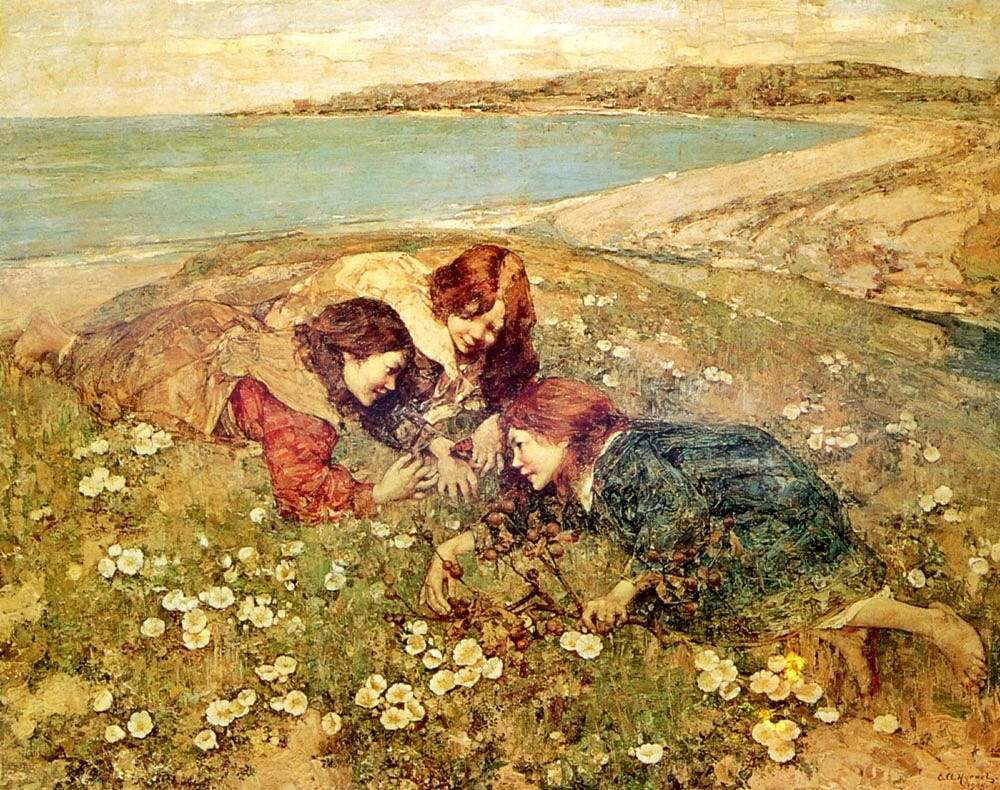
The child crouching over the beetle has noticed something outside himself, discovered that he does not understand it, and now he has questions. The stage is set for learning to take place.
The Desire to Know
Aristotle (384-322 B.C.) opens his Metaphysics with a blunt claim about human nature: “All men by nature desire to know.”1
A few pages later, Aristotle tells us where philosophy begins. He is looking back to the first men who tried to understand the world:
It is owing to their wonder that men both now begin and at first began to philosophize.
The first philosophers wondered about the moon, the stars, and the origin of the universe. Those are large subjects, but the inquiry began in ordinary perplexity. Something was there. They did not know why, and they wanted to know.2
For Aristotle, wonder is more than a pleasant feeling added to a lesson after the serious work is complete. It begins when we admit that reality exceeds our present understanding.
More than two thousand years later, Charlotte Mason (1842-1923) began her educational philosophy from a remarkably similar conviction. Her famous first principle is only four words long: “Children are born persons.”3A child is not raw material waiting for an adult to give it shape. He already has a mind and a will, an imagination, and an appetite for knowledge.
Begin there, and the parent’s work changes considerably. We do not have to manufacture curiosity and somehow insert it into a child. We offer food for the mind, give direction when it is needed, and try not to crush the appetite already present. In practice, that last part can be the hardest.
A Mind Is Not a Bucket
Much bad teaching begins with an innocent mistake: We imagine that the adult is active and the child is passive. The teacher knows; the child does not. If this is true, then education must consist of moving facts from one mind into the other, rather as one might transfer milk from a carton into a glass.
This view gives the teacher a great deal to do. Every fact must be reduced, explained, sometimes explained again, and then reviewed. The lesson grows more elaborate while the child grows less necessary to it.
Mason rejected this picture. The child’s mind, she wrote, is “no mere sac to hold ideas,” but a living thing with an appetite for knowledge. “The mind feeds on ideas,” and therefore children require a generous intellectual diet.4 This helps explain her preference for worthy books over prepared morsels of information. A living book gives the mind something to picture and question. As for the child, he may love it, or he may resist it. Such is the nature of persons.
Consider a history lesson. A child may memorize that Alexander invaded the Persian Empire in 334 B.C. The fact matters; there is no virtue in getting the date wrong. But Alexander becomes more than an entry on a timeline when we meet the young, ambitious man who, according to Plutarch, carried Aristotle’s edition of the Iliad on campaign. Why did his men follow him? Why did they finally refuse to go farther? And what happens to a man who gains nearly everything he wants?5
Dates give the story its bones. The questions make the child want to look again. Mason described education as “the Science of Relations”: A child enters the world capable of forming relationships with nature and number, stories, people, places, and God. We cannot teach him everything about even one narrow corner of life. We can spread the intellectual feast, as Mason would say, and allow the child to establish as many sound relations as he can.6
The teacher’s role is more modest than filling a bucket, though it is no easier. We cannot perform the act of knowing for another person. We can place him before something worth knowing and allow him to look. As Hannah often told her public classroom students, “you can lead a child to an eduction, but you cannot make him learn.”
The Trouble With Useful Knowledge
We live under considerable pressure to explain the usefulness of education. Why study Latin? Will Greek mythology appear on the entrance examination? How will poetry help a child find employment? Is there a practical return on an afternoon spent watching ants carry crumbs?
The questions deserve an answer. Children must learn to read and calculate, to work, keep promises, and meet the ordinary demands of adult life.
Aristotle observed that some forms of knowledge are pursued for the sake of something else, while the highest kind is desired for its own sake. He called such knowledge free because it does not exist merely as the servant of another end. Other knowledge might be more practical, he conceded, but none was better than wisdom sought for itself.7
Mason saw the same danger in modern schooling. She objected to an education shaped chiefly as preparation for a profession or trade. Professions and trades were worthy pursuits. A child, however, was more than his future occupation.
If usefulness becomes the final measure, the beetle on the path has little claim upon us. A fairy tale and a sonnet fare no better. We begin asking how quickly a lesson can produce a measurable result, and the child soon learns to ask his own version of the question: “Will this be on the test?” It is the natural end result of a purely utilitarian education. And he will continue asking it. Hannah lost count of how many times she answered this question in her high school classroom, and when the answer was no, watching the students visibly tune out of whatever was being discussed.
Mason’s criticism of science teaching was especially sharp. She recalled a little girl who, after trying to explain why a leaf is green, wrote that she thought it wonderful. Mason believed the child had found what made the study of nature worth pursuing. Elsewhere she put the matter plainly: “Where science does not teach a child to wonder and admire it has perhaps no educative value.”8
That is severe, but consider the alternative. A child can label the parts of a flower and scarcely notice the flower in front of him. He can recite the planets without looking up, or complete a page about evaporation while a cloud gathers outside the window. All the information may be correct. The lesson has still missed something.
Wonder Is Not the Opposite of Knowledge
There is a sentimental version of wonder that would leave children in a permanent fog of amazement. Naming the bird might spoil the mystery, or the physics of a rainbow might drain away its beauty. Better, on this account, to protect the child from facts and preserve the enchantment.
Aristotle would have found this strange. Wonder begins in ignorance, but the wondering person wants an explanation. He asks why the moon changes shape, then learns about sunlight, shadow, and orbit. The first question receives an answer; others follow. Knowing why the moon waxes and wanes does not make it dull.
Mason, too, wanted children to know names and laws, dates, poems, places, and causes. She objected to facts cut loose from the ideas that give them life. In A Philosophy of Education, she called for a broad curriculum in which facts arrived with the ideas that gave them meaning.9
Wonder moves the child toward the thing; knowledge gives him a firmer hold upon it. What he learns changes what he can see. Often, it also gives him more to wonder about.
Adults lose this habit easily. We learn the name of something and feel that we have accounted for it. This is a maple. That is Orion. The bird is a cardinal. A label can close the case.
Children are less easily satisfied. They want to know why the maple drops its leaves, why Orion disappears for part of the year, or why the cardinal is red. Their questions can be exhausting. They also expose the difference between possessing a word and possessing knowledge. Sometimes the most honest answer is, “I do not know. Let’s find out.”
How Wonder Is Lost
A child’s wonder can be lost. He can learn that his questions are inconvenient, that every subject consists of predetermined answers, and that adults value a correct response more than an attentive gaze. None of this has to be stated aloud.
Drudgery is not the only danger. A lesson loaded with noise, props, rewards, and frantic activity may leave no room for the quiet surprise of the subject itself. The teacher becomes a performer because no one trusts the book, the bird, or the child’s mind to hold attention.
There is a place for delight. There is also a place for memorization and for work that does not feel magical. A child must learn multiplication tables on days when he feels no wonder at all. He must practice the scales and finish the page. Appetite does not abolish discipline.
Narration offers a useful corrective. After a child hears or reads a worthy passage, we ask him to tell it back in his own words. The broad request does not reveal which details an adult has decided are important. He must attend and decide what belongs in the telling. His narration may include something we barely noticed. Good. There is a mind at work.10
Keeping the Door Open
What does this look like tomorrow morning? Usually, nothing grand. Wonder does not require elaborate arrangements.
You might begin with a book substantial enough to provoke a real question. Keep a magnifying glass where children can reach it, and find the country on the map when a place name appears. Go outside sometimes without turning the walk into a lesson. When a child asks a question, resist the urge to bury him beneath everything you know. “What do you think?” may carry the conversation farther.
There will also be mornings when the baby is unhappy, an older child is stuck on division, and no one displays the smallest appetite for knowledge. On such a day, it may be enough to read one good page and close the book. Do not become discouraged. These are suggestions, not a new system, and education is not won or lost in a single magnificent lesson.
We can also leave some interests alone. A child may draw birds without building a portfolio, read about ships without starting a unit study, or spend a month constructing an imaginary kingdom that satisfies no state standard. Some interests bear fruit much later. Others seem to bear none, at least none that an adult can measure. The time was not wasted.
The World Is Speaking
Aristotle understood wonder as the beginning of philosophy. Mason placed it near the heart of living education. For Christians, the world itself gives us reason to wonder.
“The heavens declare the glory of God,” sings the Psalmist, “and the firmament sheweth his handywork” (Psalm 19:1, KJV). Day speaks to day, and night shows knowledge.11 Christians receive the world as creation, intelligible because it was created. Our desire to know belongs within that order.
Wonder, then, is more than astonishment. It is a fitting response to a world that we did not make, filled with creatures whose existence we did not arrange. We can discover its laws, but we did not establish them. Even the smallness of the beetle becomes curious once we stop taking its existence for granted.
Proverbs gives us a marvelous picture of inquiry: “It is the glory of God to conceal a thing: but the honour of kings is to search out a matter” (Proverbs 25:2, KJV).12
The child on the path bends down for a better look, and we should be slow to hurry him past the beetle. There will be time for arithmetic, tied shoes, and the cup waiting on the table. These things matter, but education also includes the meeting of a person with a world he did not make, a meeting that no schedule or method can accomplish on his behalf.
Aristotle called the beginning of that meeting wonder. Charlotte Mason built an education that tried to keep it alive. Tomorrow morning, we can at least leave the door open.
Christopher Shields, “Aristotle,” The Stanford Encyclopedia of Philosophy, substantive revision August 25, 2020; Aristotle, Metaphysics, Book I, Part 1, trans. W. D. Ross.
Aristotle, Metaphysics, Book I, Part 2, trans. W. D. Ross.
Charlotte Mason (1842-1923) was a British educator who established the House of Education, a training institution for governesses, in Ambleside, England, in 1892. See the Armitt Museum and Library, which houses the national Charlotte Mason archive. Her first principle appears in Charlotte M. Mason, An Essay Towards a Philosophy of Education (London: Kegan Paul, Trench, Trubner & Co., 1925), “A Short Synopsis.”
Mason, An Essay Towards a Philosophy of Education, “A Short Synopsis,” principles eight through ten.
Plutarch reports Alexander’s devotion to Homer and his use of Aristotle’s recension of the Iliad in Life of Alexander, 8.2. Arrian records the army’s refusal to continue east at the Hyphasis in Anabasis of Alexander, 5.28-29. Alexander crossed into Asia in 334 B.C.; see Ernst Badian, “Granicus,” Encyclopaedia Iranica.
Mason, An Essay Towards a Philosophy of Education, “A Short Synopsis,” principle twelve, and Chapter X, “The Curriculum.”
Aristotle, Metaphysics, Book I, Parts 1-2, trans. W. D. Ross.
Mason, An Essay Towards a Philosophy of Education, Book II, Chapter IV, p. 318, for the child’s account of the green leaf; the sentence beginning “Where science does not teach a child to wonder” appears in the “Geography” section, p. 224. See also Charlotte Mason Institute, “Mason’s Methods of Science Instruction: Introduction.”
Mason, An Essay Towards a Philosophy of Education, Chapter X, “The Curriculum,” including her discussion of a single reading followed by narration.
Mason, An Essay Towards a Philosophy of Education, Chapter X, “The Curriculum,” including her discussion of a single reading followed by narration.
Psalm 19:1-4, King James Version.
Proverbs 25:2, King James Version.